
“Perhaps even more than a daughter mourning the passing of her mother, I mourn her as a writer who has just lost her most enthralling subject.”
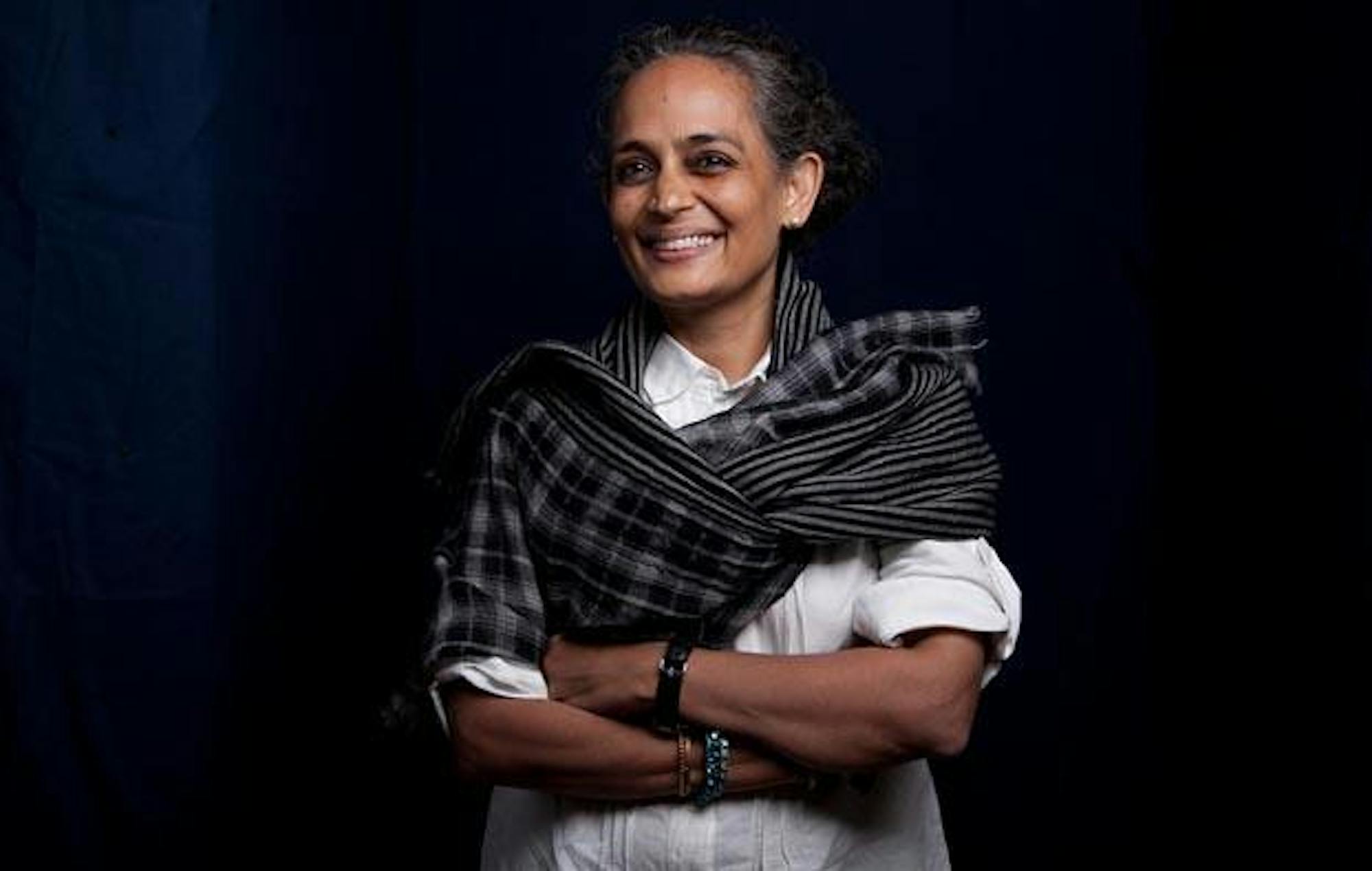
Arundhati Roy strikingly muses, cigarette in hand, on the cover of her latest memoir, “Mother Mary Comes to Me.” Her contemplative gaze masks emotional turmoil, audacious pluck and good ole’ mischief. Across 352 pages, she takes us through a life spent navigating uncharted waters with little trepidation. The unpredictable undercurrent of this stream is the eponymous character she describes as her “shelter and her storm:” Mary Roy.
Mary Roy was an educator who founded the Pallikoodam school in the town of Kottayam, Kerala. She successfully challenged the State of Kerala’s inheritance law for Syrian Christians, which was changed to grant equal inheritance rights for women in the community. As the title indicates, she is the author’s mother — but above all, she is a human. That is how Mother Mary sees her, and insists we see her too, which is all too well established by Roy’s decision to refer to her throughout as “Mrs. Roy.”
The book is as much about the performance of parenting as it is about the ties that bind. Attacks of Mrs. Roy’s trenchant asthma become reminders of the protagonist’s dependence on her mother. Early on, she becomes an “organ-child,” in a confused response to affliction and consequent anger. While the author attempts to breathe for Mrs. Roy, she is met with slurs like “fool,” and “b----,” and in stark contrast to her self-image as a lung, a “millstone around my neck.” Yet, Mary Roy also proclaims she loves her daughter “double,” taking on the roles of both mother and father as a single parent. She brings the writer her first typewriter after a long separation. She invites the fearless activist to speak at Pallikoodam.
Mrs. Roy provides a harsh kind of nurture to her offspring. A tough childhood spent on the banks of the Meenachil river nourishes Roy’s deep bond with the environment, motivating her activism against the “Big Dams” threatening the Narmada River. Her “private pact” with the water body breathes life into her Booker prize-winning book “The God of Small Things.” An outburst of anger and smashed teacups move her to leave home at 18 in her second year of college, finally freeing the organ-child to breathe in her newfound independence even as she loses her home. “She taught me to be free, then raged against my freedom,” she wrote. It is in a moment of rootlessness that the writer finds retrospective grounding and reclaims the narrative, learning to balance being Mrs. Roy’s daughter with being Arundhati Roy.
Both mother and daughter’s personal stories are intertwined with the larger political and cultural shifts that have taken place throughout the author’s life. A staging of the famed musical “Jesus Christ Superstar” organized by Mrs. Roy is prevented by the devious machinations of the local district collector, charging her with offending Christian sentiments. The incident takes place in 1990, in the prelude to a paradigm shift in Indian history. A prominent Bharatiya Janata Party leader, L.K. Advani, had kickstarted a ‘rath yatra’ (chariot pilgrimage) to whip up religious fervor for the demolition of the Babri Mosque in Ayodhya, Uttar Pradesh, that was purportedly built on the destroyed birthplace of the Hindu deity Ram.
While Mary Roy’s case eventually finds its way to the Supreme Court (after accusations of blasphemy and police raids) and the musical is finally enacted in Kottayam, the rath yatra crescendoes in the mosque’s destruction in 1992, igniting sectarian violence across the country and setting the stage for the greater rise of the Hindu right. To borrow from “Superstar,” man’s weaponization of myth had set tolerance on fire in the quest for a messiah.
The author insightfully explores the nuances of the contentious relationships of the characters in her life. Mrs. Roy’s brother, G. Isaac, attempts to evict her from their deceased father’s home after she leaves her husband; she takes him to court over inheritance rights and oversees his removal by the police. However, in their old age, he visits her regularly, sings at her funeral and retains his endearing nickname for her, Mart (derived from when she was a child and couldn’t write her ‘y’s properly, hence her ‘Mary’s’ looked like ‘Mart’s’). The writer attributes this to the fact that “nobody else would have made the battle entertaining or worthwhile.”
The most intriguing relationship of this memoir, however, is between Roy and India. “The more I was hounded as an anti-national,” she wrote, “the surer I was that India was the place I loved, the place where I belonged.” Her commitment comes through in the power of her pen: criticizing the jingoism of India’s nuclear posturing in 1998, when she condemns the unpredictable dangers of everyday life in Kashmir, justified in the name of security. She is tried for obscenity, adjudged seditious and an actor-politician even suggests that she be tied to the front of a jeep and used as a human shield during military operations. Yet she remains undeterred.
Roy has become one of the most fearless voices for social justice in contemporary India; no one is safe from her razor sharp words, be it the Hindu right or neoliberalism. It is when Mrs. Roy expresses illness-induced bigotry that she viscerally triggers her daughter’s long-suppressed reaction in one of the most powerful moments of the book.
Mrs. Roy’s recovery after a sudden 2007 health crisis is punctuated by a sudden obsession with the religion and caste of those around her. One night, the sleepless, stressed author is called to her mother’s bedside to summon the nurses, who are dismissed as “those Parayas” (a caste epithet). Eschewing words, instinct takes hold as she picks up a chair and smashes it, watching the vibrations literally travel across the floor to her mother’s body. “I thought I had killed her. But I hadn’t. I had only killed a part of myself,” she reflected. It is the “fetid threats of caste and feudal hierarchy” that finally provoke “that twisted, matted anger.”
“Mother Mary Comes to Me” is ultimately about reconciliation — personal and political, patriotism and sedition, mother and human. Roy is a brave helmsman, guiding her reader on a boat adrift in choppy waters. From the tsunami-like impact of “The God of Small Things” to the violent winds of political change, she weathers each challenge with sheer grit (liberally infused with dark wit). Her greatest challenge is the tempest she calls Mrs. Roy. By the end, she succeeds not by passing through the storm but by finding shelter in its eye. She accepts her mother as “dreamer, warrior, teacher” (as engraved on her headstone).
And then, when she is finally on the shore staring at Mrs. Roy’s indomitable psyche walking on water through binoculars (which she clarifies are made from her hands), she signs off, “Bye-O, Mart Roy. I’ll be seeing you.” The organ-child turned writer breathes in, and the air is fragrantly bittersweet.



