
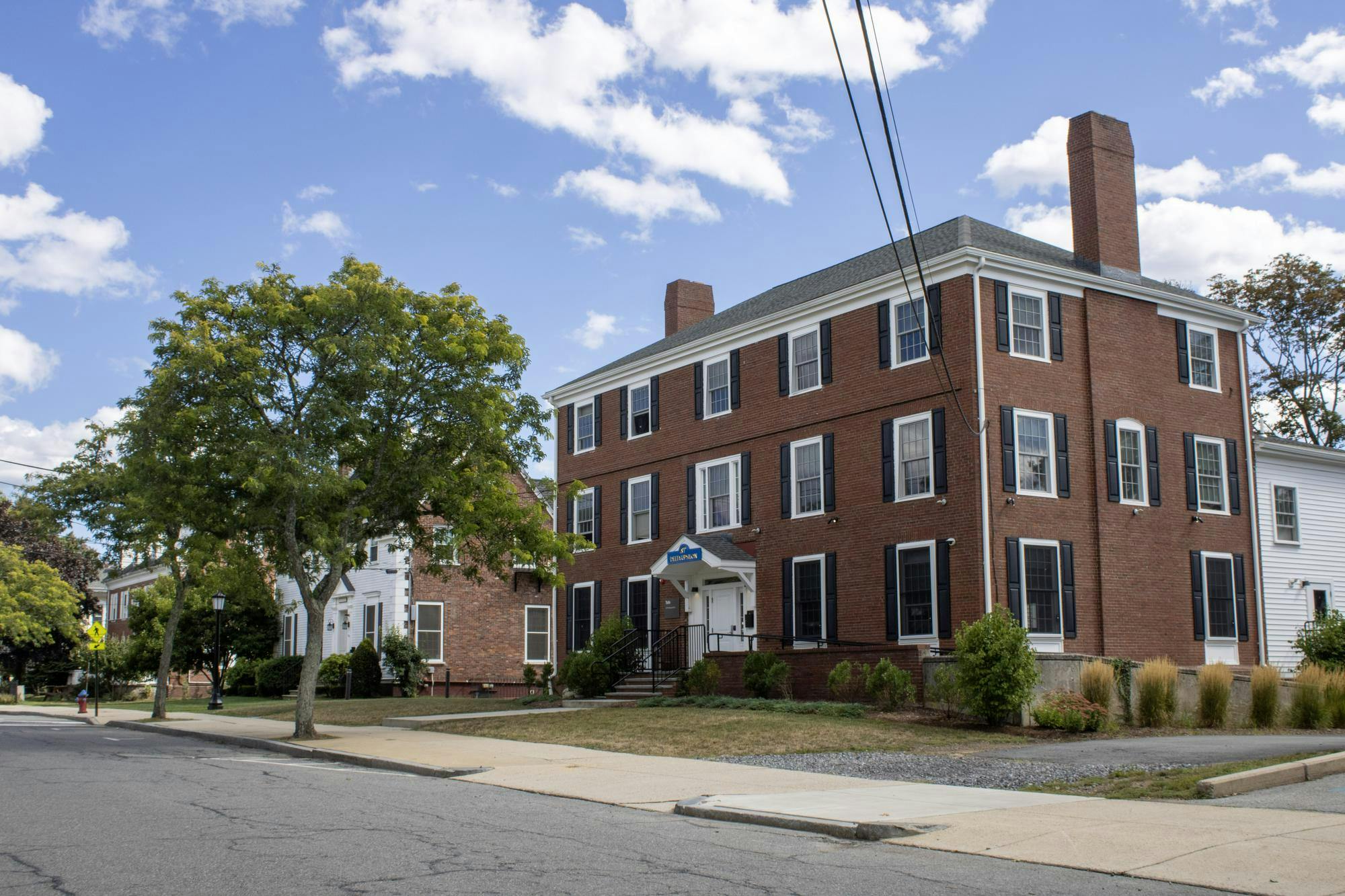
Multiple Greek life organizations at Tufts University have had their houses’ basements closed this semester due to requests from Fraternity and Sorority Life. Greek life has recently also seen an increased amount of regulation and monitoring, with two fraternities — Delta Upsilon and the ATO of Massachusetts— being on some form of probation. These measures have hindered some organizations’ abilities to host events.
Greek life representatives see the restrictions FSL has been imposing as arbitrary and inconsistent.
Addressing FSL’s reasoning for the basement closures, Theta Chi President Trevor Wallace, a senior, cited a fruitless, summer-long appeal process.
“I asked to bring a fire marshal, I was told no,” he said. “I went through every route of rational explanation … our basement has sprinklers, it has fire alarms, it has lights … it has an emergency exit. ... We were just told that it was arbitrarily unsafe.”
He also noted that “other organizations received almost no notice at all, just right before the start of the semester.”
FSL Advisor Mary Kate Kelley explained what prompted the closures in an email to the Daily.
“Ownership and management of the spaces transferred from Walnut Hill to Tufts, which prompted a review of these spaces,” she wrote. “Most other wood frame houses do not have access to unfinished basements as it has been a priority to move laundry out of unfinished basements.”
Kelley cited numerous specific elements including ceiling height, ventilation and placement of mechanical equipment and structural supports, and concluded that the basements “do not meet the quality and safety standards” for campus housing and are “not suited for living or social gathering space.”
Fraternity representatives see the basement closures as one part of a wider series of frustrations between FSL and Greek life.
"We were told right before the start of the semester that they were removing all soap and toilet paper and cleaning services from our house,” Wallace said.
ATO Vice President MG Beastrom, a senior, noted that the maximum number of non-residents allowed in their house at one time is 15.
With 90 people in ATO this semester, Beastrom said the new restriction “presents a really difficult situation where any time we just have a gathering of all of our members. … If the police come and they report something that the school doesn’t like … they will assume that we are having … an unregistered party, and that can be grounds for probation.”
Representatives repeatedly mentioned a lack of transparency in communications with the administration.
Ivy co-presidents Amelia Lee and Gracie Preminger, both seniors, referenced an unclear chain of command alongside vague reasoning being given for restrictions, while Wallace cited “shifting goal posts” contributing to “a culture of mistrust between fraternities and administration and [the Office of Residential Life & Learning], which has made it very difficult for us to get things done.”
Wallace emphasized the precautions fraternities take to ensure safety at parties.
“We are extremely highly trained as both individuals and as an organization,” he said.“We are all green dot trained, we’re TIPS trained, … we register our parties, we have sober monitors, TUPD walks through our parties and does check-ins … which [is] an extremely high bar for an organization like ours that we have to meet in order to even have these types of events.”
This was echoed by the Ivy presidents, who mentioned how fraternities at other schools do not go through the same level of precaution. Lee, a transfer student from Northeastern, noted the distinct level of security within Tufts’ Greek life.
Beastrom discussed concerns about how the new restrictions could lead students to find other, less safe ways to consume alcohol.
“We wanted to do a freshman Greek Week, so there could be parties for [freshmen] to go to. … We’re not allowed to do that because it’s considered promoting drinking,” Beastrom said. “It’s better to do [events] with eight sober monitors and a place that’s built for that [rather] than in your friend’s basement getting ‘TEMS-ed’ in Miller.”
“Students are going to leave campus to pursue alternative social scenes,” Wallace added. “That’s inevitable, and by doing so, the university is forcing them into unsafe and unfamiliar situations.”
Beastrom and Wallace also shared concerns about mixed messaging between different levels of the university administration.
“I don’t think that the upper administration really knows that we’re being put through all of these hurdles, and it’s been difficult for us to get to a place where we can communicate with upper administration, because we’re constantly being forced to move through lower administrators prior to that, and kind of being told ... this is already the decision,” Wallace said.
“We believe that the school is trying to push for more Greek life; [but] there [are] two forces happening,” Beastrom said. “Sunil Kumar says he wants more Greek life on campus, but we also are seeing … [that] there’s nothing to do at night.”
Kelly said in her email statement that there is no plan to reopen basements in the future. However, Wallace noted that fraternities have found a way to move past these restrictions.
“I think that Greek life on campus is in a position where it really should be and can be thriving,” he said. “And we’ve been able to contribute to a very vibrant social [and] philanthropic brotherhood involvement and rush output, especially in the past two years, and we have been able to successfully pivot through these bureaucratic speed bumps.”



