
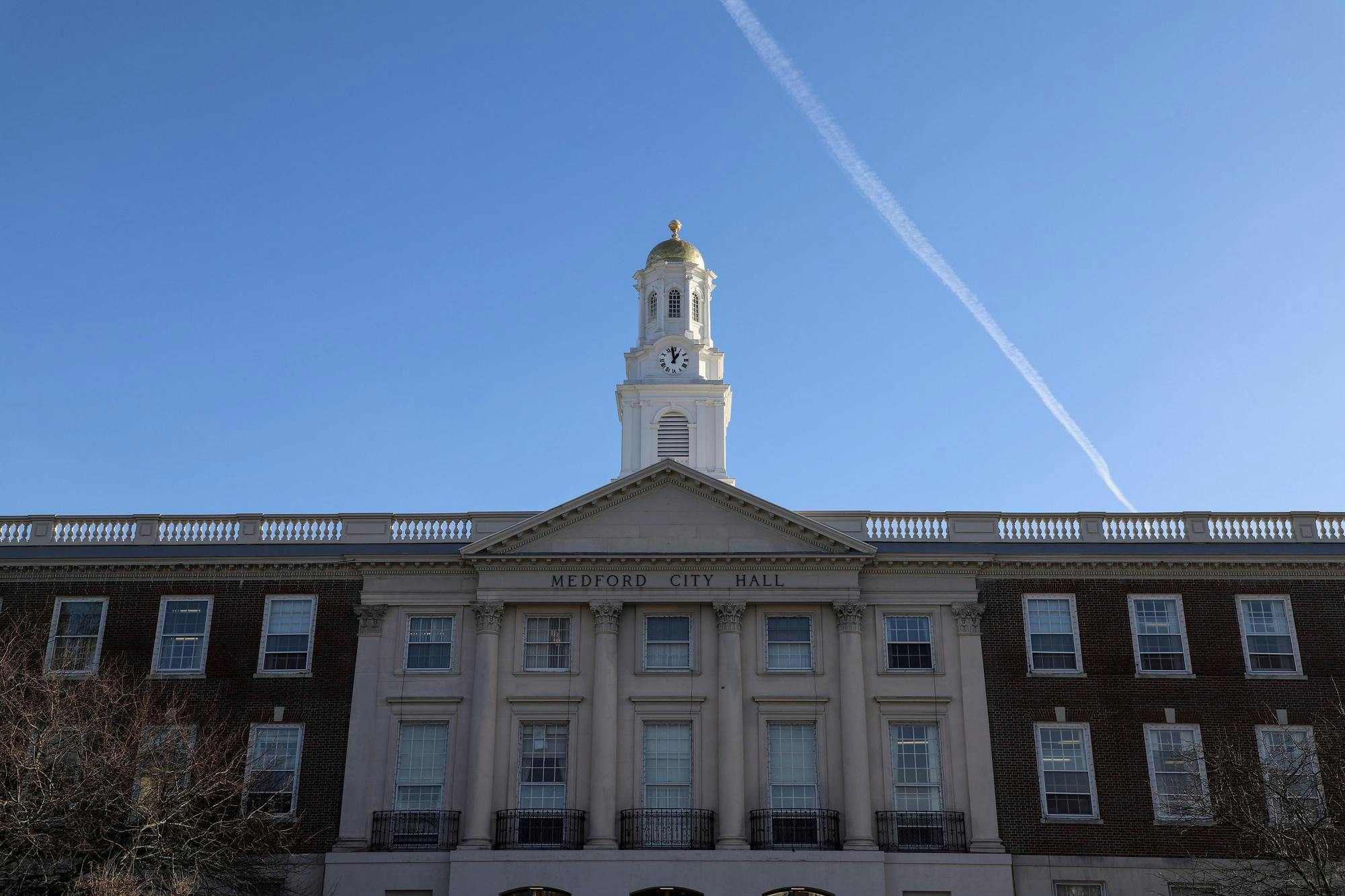
The Daily is conducting interviews with incumbent City Council candidates ahead of the municipal election on Nov. 4 where residents will be able to choose up to seven candidates. This story will be updated with additional interviews as they are completed. All interviews have been edited for length and clarity.
Editor’s note: George Scarpelli did not reply to a request for an interview.
Tufts Daily (TD): Could you start off just telling me a bit about yourself and your history in Medford?
Emily Lazzaro (EL): I am a current city councilor, serving in my first term right now. … I moved to Medford in 2016. I have two kids: They are in third and fifth grade at Brooks Elementary School. My husband and I live in West Medford. My background is in the arts, but I have worked in higher education and then shifted my career in 2017 to study public policy, and I worked in the State House.
Zac Bears (ZB): I’m the City Council president, and I’ve been on the City Council for six years.
Matt Leming (ML): I’ve been a city councilor for one term in Medford. I’m running for a second term. I worked as a postdoc at Massachusetts General Hospital for five years and since switched to industry. I’m a scientist … I couldn’t afford an apartment in Medford; I could only afford a small room over in South Medford and realized that the city didn’t really have a whole lot of support for affordable housing, so I lobbied City Council at the time to instate an Affordable Housing Trust and then decided to make a run myself, knocked on a whole lot of doors and ended up getting elected in 2023, and started serving in 2024.
Anna Callahan (AC): I’m a software engineering manager and mom. My son is 11. I’ve been living in South Medford for a number of years, but I just bought a house in West Medford, so I’m very excited to be a new homeowner.
The most important thing to me as an elected official is democracy and engaging people in the political process. I take it very seriously that over 90% of the residents of Medford will never reach out to their city councilors or come to a City Council meeting. So I take it upon myself to set up listening sessions in the community, and I have a team of volunteers that helps me with the logistics of making that happen.
Justin Tseng (JT): I’m currently a city councilor here — I have been since 2022. My parents moved to Medford over 20 years ago to pursue careers in science. I was raised in Medford, and I like to say Medford raised me as well. My parents were working very hard, paycheck to paycheck, and for me, it was Medford that gave me the parks that I grew up playing in, the library that I borrowed so many books from, and the after-school program at the McGlynn [Elementary and Middle School] that I returned to as a volunteer almost every day after school for years.
TD: What’s your motivation for running for another term? What makes you unique as a candidate?
EL: I’m on the [Medford Comprehensive High School Building Committee] as the City Council representative. Since my kids are in the [Medford] schools and I used to work for the superintendent, I have a unique insight into the connection between the city side and the school side.
I also have done a lot of work in my first term around road safety for pedestrians and cyclists. ... Last winter, two pedestrians were killed in crosswalks, and it became a really high priority for me as a result. … I started working with advocacy groups like WalkMedford and state agencies like [the Massachusetts Department of Transportation] and [the Department of Conservation and Recreation]. Both of the deaths happened on state-controlled roads, so there’s a lot of finagling you have to end up doing to get those state agencies to make changes to their roads.
I also want to … focus on investing in commercial development and making sure that we have laws that make it easy for businesses to come in and invest in Medford, so they can bring in tax revenue from businesses … It’s a great way to increase offerings without having to increase taxes on residents.
ZB: I am really excited to be running for my fourth term … to keep working and executing on our city’s comprehensive plan, our work to fund our schools, our work to address the state of our roads … and to keep building a more inclusive City Hall that serves residents better, that communicates with and engages … more residents in the work that the city is doing.
I think my experience on the City Council, my clear platform and plan for where we should go, [and] my ability to bring people together, have difficult conversations [and] make hard decisions … are all assets that I hope … voters will entrust me to keep bringing to the City Council.
ML: I’ve done a lot of work this past term trying to get Medford out of its stagnancy. Basically, we’re a city where housing is too expensive and our budget is very strained and I, along with my colleagues, have been able to do a lot of good work [in] addressing those problems. Coming up with revenue streams for the Affordable Housing Trust is one of those, updating our developer impact fee programs, working on ways to change our development rules to make it clearer for developers so that we can expand our commercial tax base and passing the city’s first ever Proposition 2.5 override to get more money for a road repair crew in the Department of Public Works, as well as 7 million to the public school system to not only avoid layoffs, but invest in arts and vocational programs as well.
I’m looking forward to continuing work in changing laws around development so that we can get more smart growth within Medford, which is pretty necessary to address the dwindling budget. … I work very well with veterans. I’ve put in a lot of work into benefitting veterans around the community, instituting an emergency fund for in-need veterans, as well as the first-of-its-kind program to house veteran renters. … I also tend to be the most open of the candidates when it comes to my role as an elected official … I tend to release a blog post every two weeks [on my website] and that helps to educate the average person as to what’s going on in the city and city government.
AC: What I just told you is what makes me unique and what motivates me to run. I do listening sessions, but those usually end up with some sort of a project happening out of them. I run teams of volunteers; I currently have five different teams of volunteers working on different projects. That is what truly does make me unique.
I really have a vision of a Medford, which is, I have to say, very similar to what came out of the many years of planning that the city did, culminating in the Comprehensive Plan, which is a vision of a vibrant and very connected community [where] people care about each other. I’ve been campaigning for the idea of ‘neighborhood nodes’ in our zoning, which means that within a five-minute walk of every home in Medford, there would be some little corner with a locally-owned ice cream shop, coffee shop, a coworking space, a bookstore — somewhere for people to gather with their neighbors.
JT: I first ran because Medford gave me so many opportunities, and I really wanted to give back. … [At] this moment, when I think about … what’s happening federally, at the state level and locally, I think we’re at a time of great instability. … Given all this upheaval, I want to make sure that we continue to have steady hands and bold leadership at the helm of city hall.
I’m currently the only person of color on the City Council right now, and I’m also [its] youngest member. … With that, I bring engagement with different parts of the city — reaching out to young people and immigrants and different networks [across Medford]. And I’ve been really hard at work, especially with constituent services in different languages, particularly in Chinese and Spanish, to make sure that our city hall is really serving all the people and … engaging as many people as we can.
I’m currently a law student, and I decided to go to law school because my experience in city government showed me that law is [how] we translate ideas into policy — [and] policy into action. We really need that perspective on the City Council to make sure that all the work that we’re doing is being translated into actual progress.
TD: What are some things you’ve accomplished on the council that you’re most proud of? What are your goals for your potential next term?
EL: Being able to encourage road work when there are issues is one thing; another is the gender affirming care ordinance and reproductive health care ordinance. That work I was super proud of, shoring up the rights of residents in the midst of what’s happening at the federal level. … Especially at a time when the Trump administration is making a lot of people feel really out of control, I always encourage people to think about their locality as a place where they can feel safe.
ZB: [There are] three main principles I’m focused on for our city. First, we need to become a city that says ‘yes’ to doing big things and making hard choices.
The second … is making it really clear that Medford is not for sale: We need a better deal with Tufts University, we need to update our zoning to hold developers accountable and provide community benefits. We need to stand up to the federal attacks on our neighbors and [protect] our immigrant neighbours and the essential programs that support [them].
The last piece is that we need to build a Medford for all of us. … We need to do more to make sure that City Hall … [has] the resources to communicate better with residents. … The City Council doesn’t have any resources under the mayor’s budget to communicate with residents, so that is a big area that needs improvement. I’m hoping that we can really push to hold the mayor accountable and get the budget funded to improve communication with residents and engage them more in the process.
ML: The really big priority is affordable housing. … We can allow more multi-use development, we can change laws to incentivize developers to build more affordable housing and making it so that this is a city that prioritizes [affordability] is sort of one of the focal points of my campaign.
The specific plan is continuing on with the rezoning process which is going to be really the biggest lever that we have for spurring any kind of commercial growth, as well as residential growth, particularly with mixed-use developments.
The other point is the budget. Medford has one of the lowest operating city budgets per capita of any city in the Commonwealth and that is one of those all-expanding problems that creeps over into everything else. Residents talk about there [being] too many potholes in the roads, there [not being] enough trees around the city, the schools [not being] ranked very highly — all of those things are concerns that they’re rightfully bringing to City Council. Most of it reduces to the fact that we don’t have money to support these things and so my focus is coming up with policies that can help to address that in the long term. … We need to institute policies that will allow the city to grow in the right way, which has largely been prevented over the past generation or two.
AC: I believe that we need to use some of our city savings account. I think we have more in our savings account than we need to keep in there. It’s called free cash. More in the free cash and the stabilization funds that we need to, and it would be financially more responsible for us to put about $8 or $10 million of that toward roads and sidewalks in the near future, because it costs so much more to repair dilapidated roads than it costs to repair roads that are in good shape. So the roads, the sidewalks and ramping up our ability to repair those and getting them into better shape so that we are not spending so much on them is an important thing for me.
JT: This past Council has been tremendous in terms of passing bold new civil rights laws. We have passed a welcoming city ordinance to protect our immigrant neighbors by enshrining our noncooperation policy between local police and U.S. Immigration and Customs Enforcement. When it comes to non-criminal matters, this will help re-instill trust in our city services [and] in the city in general. [We] also passed sanctuary city legislation when it comes to gender-affirming … and reproductive health care.
Up until recently, the city has been in a kind of plateauing situation where things hadn’t changed much, but there were real structural needs for reform, and that’s been the largest focus of my last few years: making sure that we are laying the groundwork for the big reform projects … we need to be doing.
The last thing is the new high school, [which many]Medford families are very excited about. We’re in the middle of the project. Things are looking very optimistic for the city — but without a strong, progressive City Council in the next term, we won’t be able to [complete it].
TD: I’m curious how you’re prepared to combat and manage the U.S. Immigration and Customs Enforcement and federal funding cuts.
EL: I think no matter what, you have to keep living truly in alignment with your values and even if somebody is threatening you, it can’t change the way you behave with regard to what you believe in and where your moral center is. … ICE is already here, funding cuts are already happening, regardless of what actions Medford takes. … But basically, if you don’t, say, pass a gender affirming care ordinance or reproductive health care ordinance, or you don’t do the welcoming city ordinance, because you think, ‘Oh, maybe the Trump administration will find out about it and take away our funding’ — they’re trying to take away our funding anyway.
So, I think that the best course of action is to do what we can to respond to our constituents when they ask for protection, to do everything that we would like to do to keep our residents as safe as possible and live in alignment with our values.
ZB: It’s truly horrific — the assaults on our neighbors [and] families in our community, people who are doing the right thing: being good neighbors, running businesses [and] working really hard.
We need to be loud and stand up … — join with other mayors [in] lawsuits to push back … and say that we don’t want this kind of behavior in our community. We need residents to keep calling this out when they see it: recording it, getting the footage in, contacting the media, reporting it to the LUCE hotline. I’d really like to see us take it to the next level.
ML: There’s limited action that City Council can take and we’ve been getting a lot of pressure to take what we can … Six days before the administration [of President Donald Trump] came into power, City Council passed the Welcoming City Ordinance, which prevented the Medford Police Department from working with [Immigration and Customs Enforcement] on non-criminal matters. That was a pretty major step, but that also happened several months before a lot of these raids really started to take effect. It’s not within the power of the city to just outright stop [raids] from happening. We can’t just block ICE from doing what they do but there have been other lines of effort. For instance, demanding periodic reports from the Medford Police Department about ICE activity in Medford, although that’s tricky because they’re not always themselves aware of when that happens.
With the Democratic City Committee, which I’m on the executive committee of in Medford, I spearheaded a campaign to distribute red cards around to immigrant communities. We also, at the most recent City Council meeting, were talking with the city solicitor about sending in Freedom of Information Act requests every time ICE abducted somebody in the community, which does help to slow the process down a little bit. … A lot of it is reactive, because you never really know what’s going to happen the next day and [is] figuring out — given what little power we do have — what concrete things can we accomplish in our roles?
I think the city could be doing more to join lawsuits and fight back in the courts.
AC: I, like many of my other fellow city councilors and many people that I’ve spoken to in Medford are very concerned — especially after the Rümeysa Öztürk video — [that] people that we know and care about in our in our city… might be basically picked up off the street with no due process at all. We passed the welcoming city ordinance, which does protect our residents from ICE, and we want to make sure that our Medford police force is focused on their job … and that they aren’t doing the job of ICE officers. That is something that we have already passed and worked on. We also did supply some information cards to folks just so that they knew what their rights are. We have asked our police chief also to inform our residents, through the open public city council meetings, of any known actions happening from ICE in the city of Medford.
JT: I think the key is to be both idealistic and realistic. The idealistic part comes from [the idea that] we should not be sacrificing [the] values that make our city what it is. [Through] my experience growing up in Medford and living in Medford, I think one of our strengths is embracing diversity and embracing our neighbors and inclusion — and we should not be giving up on those values.
When it comes to being realistic, I think we need more action plans to deal with the situations that are coming down on us. So, when it comes to funding, I think we need to be looking at how we use stabilization funds [and] free cash and prepare for worst-case scenarios.
TD: On the issue of funding cuts, are there any steps that you’re happy that the city is taking, or that you’d like to see the city take to protect itself from that threat, or just finding alternative streams of revenue?
EL: I think the best way to ensure you can have a stream of revenue that’s protected from the federal government is by encouraging commercial development, and the best way to do that is through zoning reform. Unfortunately, the mayor has paused our zoning updates because of disagreements and lack of communication. My goal for the next term is to make sure we’re developing our commercial districts, our squares and our business quarters. ... That would be an excellent opportunity for us to have much more money flowing into the city … that would be completely protected from any kind of threat of federal cuts.
ZB: I think it’s clear that the [President Donald] Trump regime is acting vindictively … [and] Massachusetts is going to be a target. Our programs are under attack. … We need to stand up and fight back. I think Medford should be more proactive [in] joining with other communities in the region to file lawsuits against the illegal actions of the Trump administration. We should band together with communities and with the state to balance out any federal cuts by making big corporations pay their fair share.
ML: With a lot of actions coming out of this administration, you really take it one day at a time, because the pattern has been something makes big headlines and then it will often just end up getting caught up in court. Personally, I think that a lot of this is also just for show. I have seen some cases where individual pieces of funding also have been a little bit more put at risk. But at the end of the day, this is about [being] willing to stand up to a bully and [being] willing to stick to your guns. In most cases you should be fiscally responsible, but if you have a situation where somebody’s saying, ‘If you let us abduct your neighbors, then you can have a few extra dollars.’ That’s a case where I'm like, ‘No, I’m not going to support that.’
AC: [The] loss of federal funds can happen to any city based upon the way that this federal government has been reacting. It is something that we need to be aware of. Should anything come up, I think we will have to look toward — [and] we already do a pretty good job of looking toward — grants and state funds. … Our city is very resilient, and I’m sure we would reach out to all of the abilities that we know of for being able to fund what we need to fund.
Aside from reaching out to our state legislators, I also run a podcast on state politics. I know a lot of people there who work in progressive politics across the state, so I have a lot of connections and obviously being able to mobilize everything we can. I do think that especially here in Massachusetts, there is a lot of will to fight against the [administration of President Donald Trump]. I think what we have seen from [Mayor Michelle Wu] in Boston is that standing up to the Trump administration and standing for our values is something that will be supported by, I think, both the people in Medford as well as folks across Massachusetts. I will also say that Massachusetts is considered a donor state and perhaps the No. 1 donor state in the entire country in terms of supporting progressive causes and political causes across the nation. I think that by standing by our values, we will find support through networks here in Massachusetts.
JT: I think my focus over the next few years will be on building up our tax base as a city. So that means new growth. It means revitalizing our local squares, bringing more customers into the city [and] encouraging [small-business] growth in the city.
Another thing that I will be focusing on is making sure that we are making big developers pay their fair share as well. And something that we have initiated this term, and I hope to carry out in the next term, is updating our linkage fees, updating our community benefits agreements with these big, big developers and making sure that we have built mechanisms to negotiate even better [outcomes].



