“Unreasonable.”
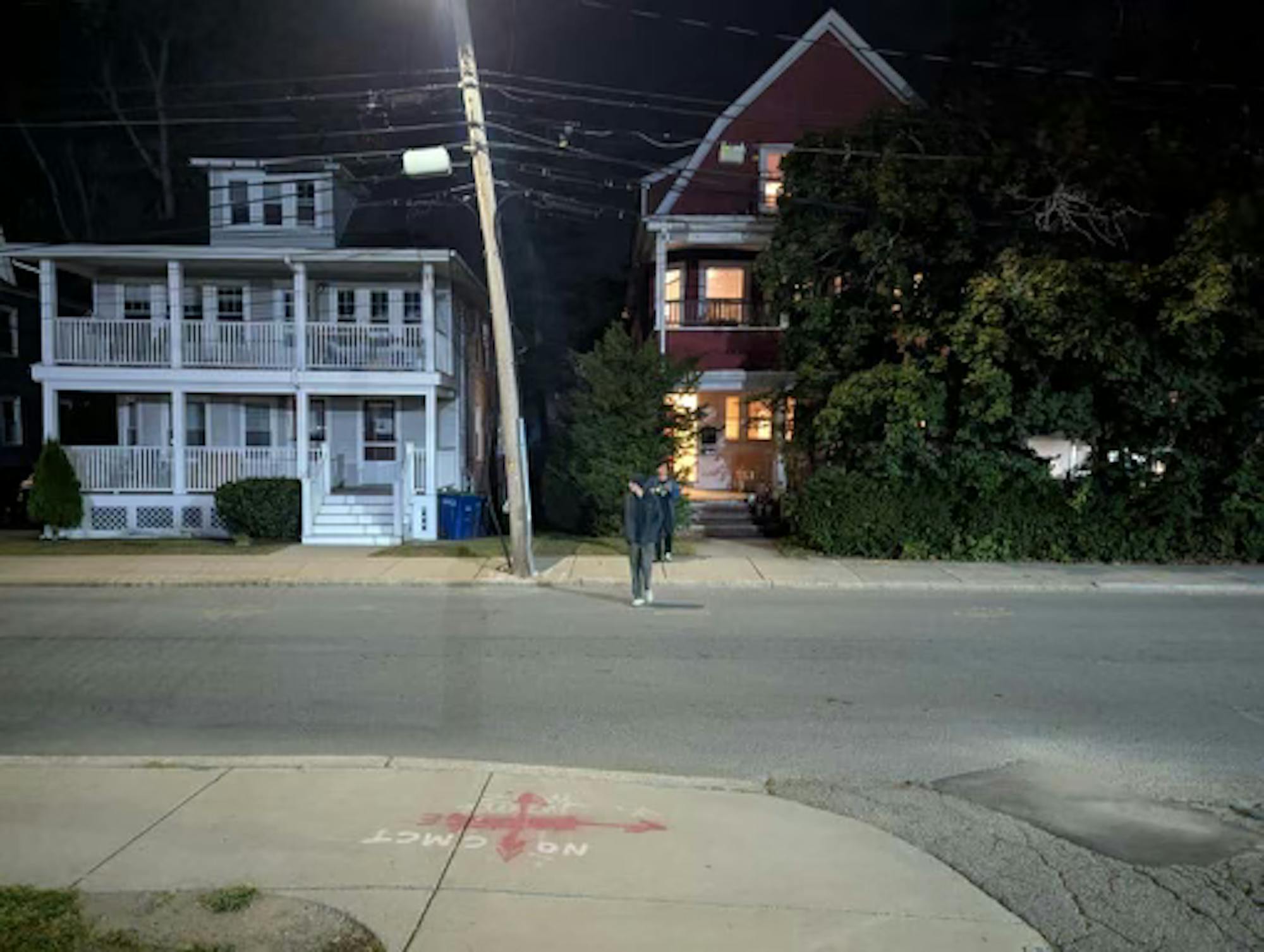
That is how one Tufts senior, granted anonymity to avoid legal ramifications, described the Somerville intersection between Curtis Street and Sunset Road. It’s an intersection that any student living on the side streets off of Curtis (known as Winthrop Street in Medford) will cross illegally anywhere from two to six times per day.
However, there is no crosswalk at this popular crossing. Those who choose to scurry across the street illegally must peer down the wide and straight road to check for the cars that barrel towards Boston Avenue. After making it across, however, one is immediately connected to campus by a sidewalk that provides a straight shot to the popular study spot, Ginn Library.
“It’s clear to anyone … that there should be a crosswalk where there’s just not a crosswalk,” the senior said. “If you were following the law, you would have to walk a minute in either direction to find an actual crosswalk, which would be an unreasonable expectation on anyone. And therefore it leads to lawlessness, because anyone … is going to cross illegally because there’s not really another reasonable option.”
Another student, junior Maddie Miniati, lives on Sunset Road and crosses the intersection every day to get to and from campus. While sometimes she opts to walk to the crosswalk at Professor’s Row and Curtis, other times that just isn’t where she wants to go.
“The sidewalk is perfectly lined up, so it should just keep going into a crosswalk. Also, because there’s a [parking lot] there, it’s hard to tell who’s stopping when, who’s turning when, and not to mention Sunset itself is sort of a hidden turn to begin with, so a lot of people miss it anyway,” Miniati said. “So I think a crosswalk there would help everyone — drivers, pedestrians.”
Miniati added that at night, “because you can’t really see over the hill, you kind of have to look out for lights … you have to watch out, because you can see the cars, but the cars can’t see you.”
For the senior, he and his friends decided they couldn’t stand idly by and watch as people continued crossing the street despite the lack of a crosswalk and the speeding cars.
“That intersection is dangerous and puts many students at risk. And so some friends and I considered, like, really, someone needs to do something about this,” he said.
One of his friends tried to get in touch with a Somerville city councilor, but no change was brought about. The student’s theory as to why no concrete action has been taken to make the intersection safer has to do with its location.
“I think part of the problem might be it’s an area that maybe is controlled by … Somerville, but it’s also adjacent to Tufts campus and directly adjacent to Medford,” he said. “So perhaps, no one body feels particular responsibility for it.”
So the student, alongside some friends, decided to take an alternative route.
Following published guidance from guerrilla crosswalk-painters in Los Angeles, the group secured ‘official’ paint for laying down crosswalks — it’s durable, water-resistant and thick. Next, they gathered the correct measurements for all Somerville crosswalks, which, notably, have different dimensions from the Medford crosswalks.
“We spent a couple nights in a parking lot nearby doing tests, seeing how long [the paint] would take to dry and seeing how straight we [can] get the lines and such,” he said.
And then in the middle of the night, the group donned high-visibility vests, put duct tape on the street and attempted to make a crosswalk.
“We got a chalk line, and we got all the measurements down. We marked … the exact measurements of where the lines should be … spaced apart as per Somerville regulation,” he said. “And then TUPD pulled up on our asses.”
After the Tufts Police questioned their actions, the group ceased its operations.
The plan was not perfect — the student said they had their concerns. One worry was that without a yield sign, if someone were to be hit by a car, they could blame the crosswalk. But, he said, someone could also be hit because it’s a dangerous intersection and there is no crosswalk.
“The main concern was that … this would be a surprise for cars. You wouldn’t necessarily know that there’s a crosswalk there,” he said.
To account for this problem, the group’s plan was also to order a “slow” or yield sign to install on either side of the crosswalk.
After the operation didn’t go as planned, the senior had little faith that Tufts would advocate for a crosswalk.
“I’ve had interactions with Tufts before, trying to get them to act locally — specifically on off-campus housing issues — in which they’ve been extremely hesitant to do anything because of potential liabilities. The university really doesn’t want to get involved in local issues, because they consider everything as a potential opportunity for them to get sued,” he said.
However, according to Rocco DiRico, the associate vice president of government and community relations at Tufts, no member of the Tufts community has brought the intersection to his attention. “If any students, faculty, or staff brought concerns to our attention, we work with the city to try and address the issue,” he wrote in a statement to the Daily.
DiRico also wrote that “the safety and security of our students both on and off campus is a top priority for the university.”
Regarding collaboration between Tufts and the cities of Medford and Somerville, DiRico said that the university “has a great working relationship” with the local communities, and has stepped in to assist during emergencies such as the COVID-19 pandemic.
“And most importantly, we support our students, faculty, and staff that volunteer at countless nonprofits, schools, and government agencies,” he wrote.
For now, masses of off-campus students will continue to cross the Sunset-Curtis intersection illegally. But maybe a crosswalk will exist one day — whether by student advocacy for a Tufts-Somerville collaboration … or by the surprise appearance of a crosswalk in the middle of the night.