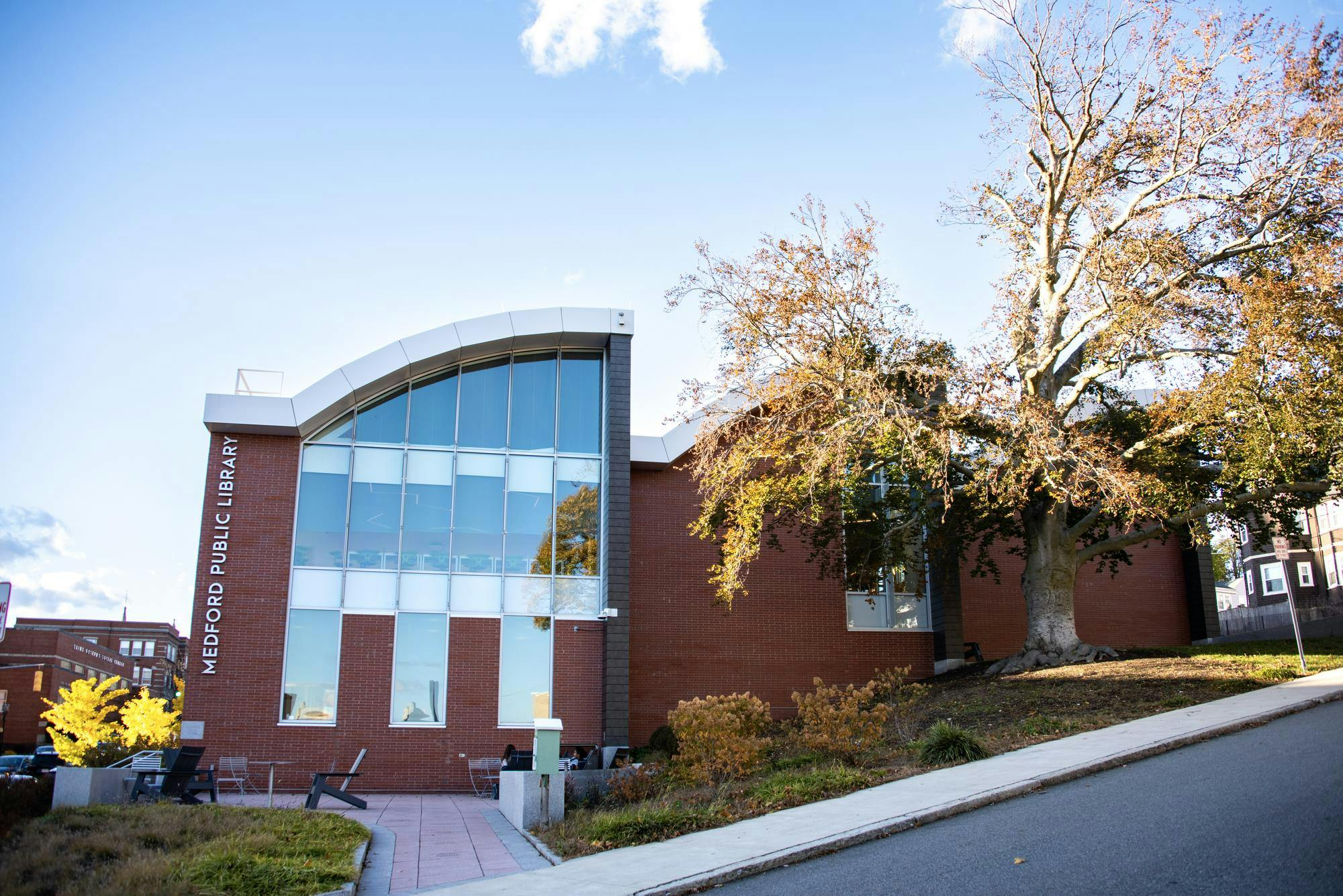
The Medford Public Library plans to build a digital database of its content following approval by the Medford City Council in late October. A soft launch of the database will be published early in 2026.
Funding for the project comes from a Bloomberg Philanthropies Digital Accelerator Program grant.
Jenna Barry, the head of reference at the Charlotte and William Bloomberg Medford Public Library, said the digitization of the library has long been in the making.
“[The creation of the digital database] has been something that we’ve wanted to do for a long time, and winning this grant made it possible for us to do it,” she said. “We were very excited to be able to undertake the digitization of all of the materials, because we know it’s going to make a huge difference when they are searchable, findable [and] viewable online.”
In establishing the digital database, Medford Public Library partnered with AM Quartex, a digital asset management company, to build the library website and train staff on how to upload and create collections.
Jessica Kowalski, associate director of sales at AM Quartex, discussed her experience working with the library team on the digital project.
“My role is just really being here to cheer them on and to support them with the tools that they [need]. They’re really doing the work. We're just here to support them along the way,” Kowalski said.
Kowalski outlined what AM Quartex has been hoping to achieve through its partnerships with the Medford Public Library and archives around the world.
“Our goal as a company is to decrease barriers to archival research. That might be through publishing collections and distributing those worldwide,” Kowalski said. “The goal more broadly is to have a tool that’s easy for people to use or to help gain visibility for collections, whether that’s locally or by researchers who might be interested across the world.”
She added that the digital archive would be able to weave connections between members of the Medford community separated by time and distance and could introduce new members of the community to the city’s history and character.
“There’s people that move to the other side of the country or elsewhere and you still want to connect, perhaps with the history or places that you’ve lived in or genealogical research and understanding where your family has lived,” Kowalski said.
Kowalski went on to emphasize the database’s important ability to create increased access to archival information.
“It’s really exciting to participate in that enablement of allowing people to engage with local history, local heritage,” she said. “For a long time, you had to go into a physical space in order to engage with them and so it made it really limiting to the people who are able to work with those materials.”
Barry spoke about how bringing modern resources, such as the digital database, fits into the library’s goals.
“We’re a library that fits a modern interpretation of what a library should be, which is not just a place to come get books and renew them, but we’re a library with a maker space, a tech lab, a recording studio,” Barry said.
As part of the grant, the library will implement Optional Character Recognition, a transcript service that scans physical materials and transfers them into files, into the new database. Through OCR, the library plans to eventually scan all of its archives.
“We’ll have local scrapbooks, lots of historical documents, lots of local authors, lists of persons [and] all of the Medford historical registers. There’ll be thousands of items in the repository by the end of 2026,” Barry said.
Barry expanded on the importance of scanning archives, which will both protect historical documents and increase their accessibility.
“We definitely want to preserve history. Some of the documents that we’re scanning are 200 years old and starting to get really fragile,” she said. “If we don’t scan them, a lot of them are going to be lost to time and degradation. … I would say our overarching goal is to make local history more accessible to anybody in town or anybody who’s interested about the history of Medford.”
Kowalski said she has high hopes for the future of the digital database.
“We’re just really thrilled and excited for Medford to come on to join our community, to see what they publish. Our real hope is that they publish initially and that they get to continue to add to their site and grow enthusiasm for their history,” Kowalski said.
In addition to receiving the grant, which is directed at nonprofits, the Medford Public Library is already closely associated with former New York City Mayor Michael Bloomberg, a Medford native, and his family, having received a $3 million donation towards its construction.