
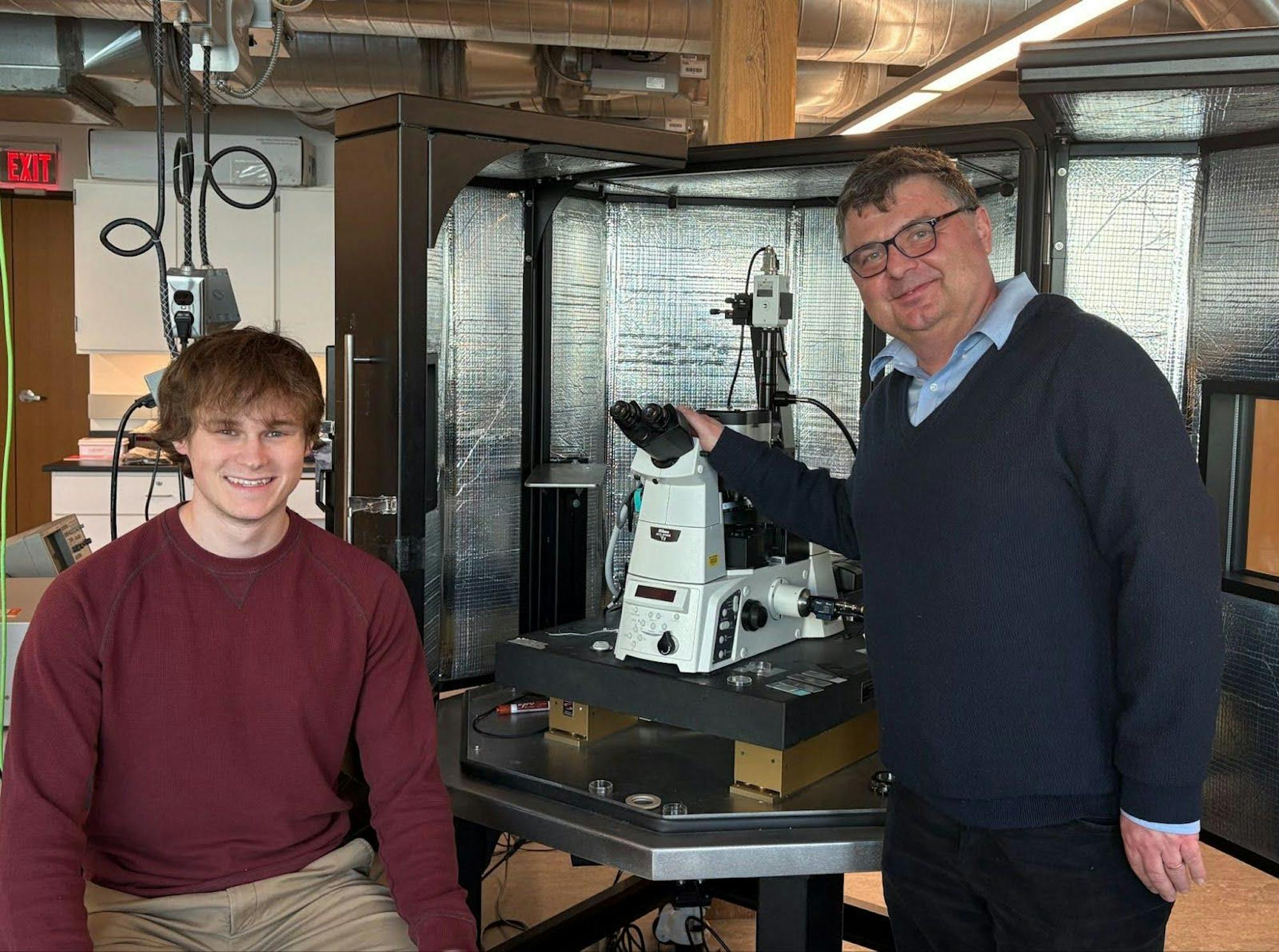
From outer space to the human brain, Tufts University’s research labs explore various fields of science to uncover new insights and develop principles to test them. Diving deep into the human brain, one such Tufts lab analyzes how neurons grow and form neural networks. Cristian Staii, an associate professor of physics and astronomy, runs a biophysics lab that operates on ex vivo brain cells, mimicking actual biological environments and utilizing atomic microscopy to analyze these cells under different conditions. By examining how neurons in neural networks function and how their mechanical properties change under different environmental conditions, the team aims to mathematically explain the brain’s complex structure. Staii devises mathematical formulas for the mechanical properties of these cells, emphasizing the importance of applying physical and mathematical knowledge to different areas. His previous work across various fields led him to his current research in neurophysics.
With a background in chemical engineering and quantum computing, Staii learned to collaborate with scientists from diverse backgrounds to grow neurons on silicon germanium substrates in different environments, observing how external forces affect cell growth and neuronal network formation. At his research lab, he collaborates with researchers from different fields. For example, he worked with Professors David Kaplan and Ying Chen in the biomedical engineering department on a project that involves encapsulating cells and protecting them from external perturbations like toxic environments.
To measure cell properties, the team used atomic force microscopy. An atomic force microscope has a metallic cantilever with a sharp tip that is used to locally push the cell and measure its physical properties. Because the microscope measures the force applied to the cell, it can be used to determine properties such as the cell’s stiffness and elasticity. Using high-resolution imaging, the volume and height of the cells can be measured.
Currently, the microscope is used for two-dimensional analysis. However, the team is also looking forward to conducting three-dimensional experiments. Staii emphasizes that the challenges in this shift come from operating in “sideways and diagonal” space rather than in planar space, as in two-dimensional analysis.
“It’s much more challenging to infer what the forces are, but we’re trying to implement that to understand this growth in three-dimension,” Staii said. “It then is a matter of adapting our models which are two-dimensional, like the stochastic differential equation, to make this three-dimensional mathematical framework.”
One of the interesting highlights Staii found surprising was that temperature played an important role in neuronal growth. He reported in his experiment that changing the environment’s temperature by a few degrees can significantly affect neuronal growth and mechanical properties. While in a different matter, like water, Staii explained that 25 versus 37 degrees would not make a significant difference. However, for the cells, they observed that in addition to longer axons, the cells’ mechanical properties also showed significant changes. These findings led the team to question whether the cells “read the mechanical cues from the environment.”
As Staii explained, using an atomic force microscope is similar to “driving:” basic operations on the microscope are easy to learn, like driving lessons, but becoming skilled takes practice (according to Staii, about six months). Using the microscope requires fine motor control, real-time feedback management, anticipating and compensating for drift and temperature effects and adapting to different samples. By becoming proficient in conducting atomic-level experiments, the team can turn their observations into calibrated mechanical parameters and predictive models by generating mathematical formulas.
In the lab, students play an important role. Undergraduate and graduate students work alongside Staii and his Ph.D. students on modeling and stochastic differential equations, developing both experimental and theoretical skills. In addition to publishing research papers, the lab provides hands-on training and independent project work.
One of Staii’s Ph.D. students, Nathan Brodeur, joined the lab after learning about Staii’s work on mathematical modeling of neuronal growth, which would allow him to combine his interests in physics and brain sciences. In his first eight months, Brodeur described gaining hands-on experience with various experimental techniques and collaborating with a large group of researchers to combine theory with practice.
“I’ve had to learn how to do basic wet lab stuff like pipetting and how to centrifuge a sample, how to manufacture the silk that we use to encapsulate the cells, all that sort of stuff … [that] I didn’t know anything about before,” Brodeur said. “I’ve also learned a lot of math and physics to do with the atomic force microscope, the very granular details of how the signal gets generated, how the signal gets processed and also, on the soft skills side, how to communicate with a larger team of people.”
Overall, the lab taught him that physics is often messier and more experimental than people might imagine and that it’s important to collect experimental data to build accurate models.
As well as demonstrating the importance of experimentation and interdisciplinary collaboration, Staii’s lab generates promising results that help scientists better understand how the human brain grows and forms neural networks, supporting future studies aimed at understanding and restoring the brain’s biological functions and intelligence.



