Updated March 24
At their March 23 meeting, the Medford Comprehensive High School Building Committee voted on six final designs for the high school.
Whittling the potential designs down from 29, committee members discussed design priorities ranging from site safety and security to ensuring strong counseling and community health support. Members also debated how a new pool might be included in the construction and fielded public questions and comments.
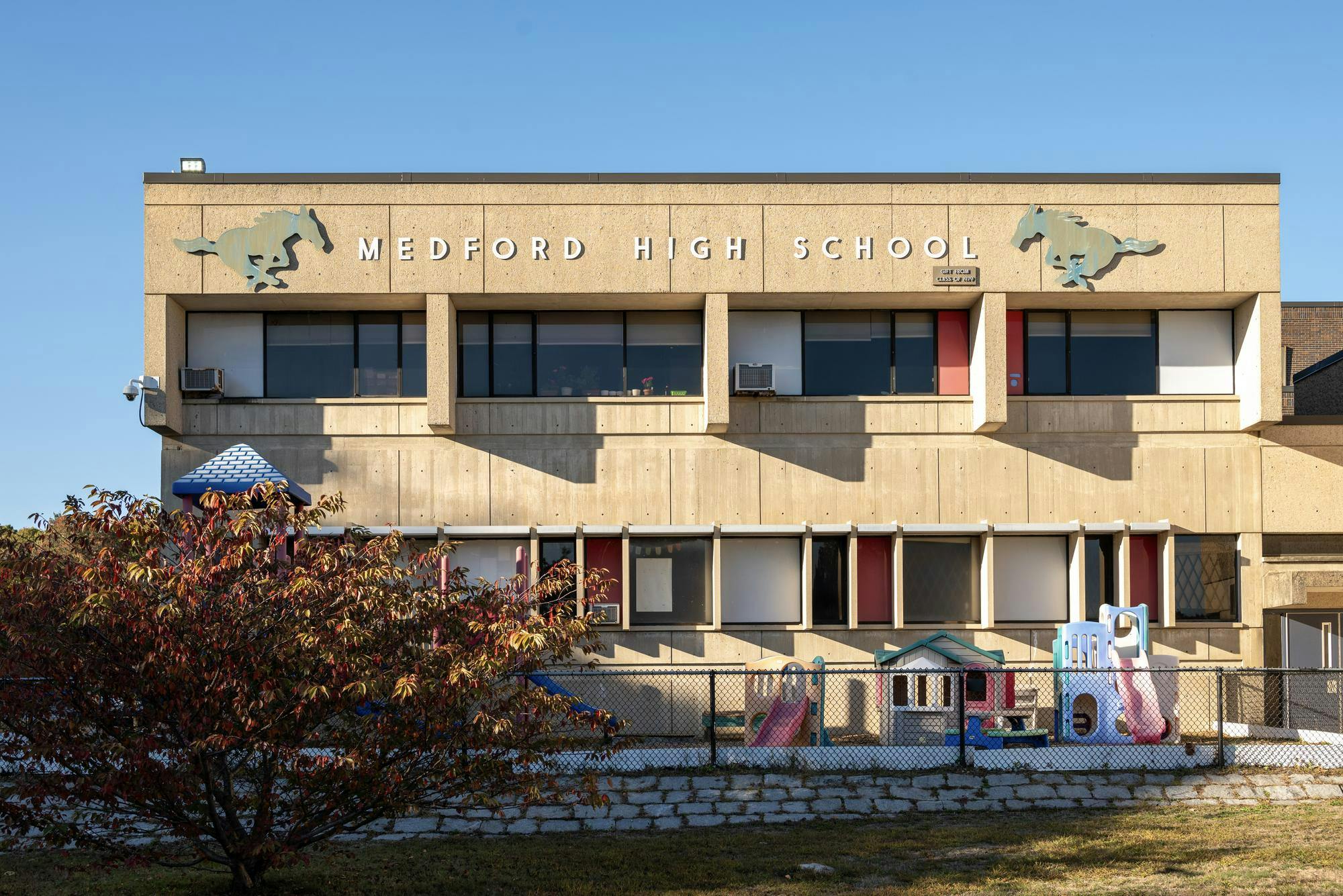
The construction plan for Medford’s new high school is in full swing following the presentation of its educational plan in January. Written by the Medford Comprehensive High School Building Committee, the plan envisions improved learning spaces and programming for students, faculty and community members.
Guided by Medford Public Schools Superintendent Suzanne Galusi and Kimberly Talbot, assistant superintendent of academics and instruction, the 58-page plan includes architectural proposals for potential classroom and learning space dimensions as well as educational goals that center on creating “human-centered spaces that support collaboration, movement and multiple modes of teaching and learning,” which are currently lacking in Medford’s high school, according to Talbot.
“The classrooms are small,” Talbot said. “There’s not space for you to get up and move into this small group. … It’s not a respectful professional space for kids to work.”
The educational plan presents goals to expand collaborative, hands-on learning opportunities with increases in flexible classroom spaces and career and technical education opportunities. Vocational programming will be more integrated into the new high school, allowing all students to be part of the same community, and will increase from 15 to 19 programs, providing more career-focused learning opportunities for students.
The educational plan also proposes a new early childhood center at the high school, combining the existing Medford Family Network and other daycare programs. Graham hopes that holding programming at a singular central location will allow for more comprehensive services for families.
The educational plan is a major feature of the feasibility study, the third module of the Massachusetts School Building Authority’s project. The process, which officially began in October 2025 after a prior failed attempt, lays out specific steps that the city must take for the MSBA to partially fund construction.
To write the plan, Galusi and Talbot collaborated with teachers, community groups and a group of ‘content directors’ who represent each of the eight academic departments. The team also visited other new construction sites to gain insight into what might be required for the new school. Project management firm LeftField was hired in June 2025 to represent the city’s goals as the owner’s project manager, and Cambridge architecture firm SMMA was hired in November 2025 as the designer.
Talbot also spent a day shadowing high school students to hear what they would prioritize in a new high school.
“We learned a lot about what students want and how they want to engage with the world,” Talbot said. “They have a lot to say about how they interact with the world around them, from how long it takes to get from one class to another … to how the room is organized.”
The Medford School Committee also played a central role in reviewing and approving the educational plan earlier this winter. The committee discussed the document during its Jan. 26 meeting and approved it on Feb. 2 before submitting it to the MSBA as part of the feasibility process.
Jenny Graham, vice chair of the Medford School Committee and chair of the Medford Comprehensive High School Building Committee, said the plan will guide future decisions about the building as the project continues.
“That building is really a hub for activity in the city, and the educational plan sort of lays out all of the ways we intend to use the building in the future,” Graham said.
City officials are also seeking input from Medford residents as the planning process continues. The district has hosted community forums and offers a mailing list where residents can review building proposals and share feedback on possible designs. The Building Committee has also held regular meetings throughout February and March to present updates and major decisions to the public.
Talbot emphasized the importance of keeping residents updated and invested in the project.
“The School Committee is really so responsive to the needs of the district and also in connecting with the community,” Talbot said. “Additionally, [the] Building Committee has worked very hard to inform the School Committee of all of these steps along the way, and the Mayor is part of both of those.”
Graham highlighted the School Committee’s goal to engage residents in the project.
“We’ll be out and busy in the community trying to bring the project to people instead of asking people to come to the project,” Graham said.
The committee is also beginning its schematic design process, in which 29 proposed designs will be voted on and narrowed down to three to five design alternatives at the March 23 Building Committee Meeting. The final preferred design is expected to be chosen in June.
City officials also hope to implement some of the education programming as early as next year. Plumbing and IT/cybersecurity vocational programs are expected to be offered to rotational ninth-grade students in the current school space, although other programs, such as dental assisting, require the new space to be offered.
“[Medford High School] is more than a high school, it’s more than the daycare, it’s more than a pre-K, it is a community space,” Graham said. “I just look forward to the day that people go there and they say, ‘This really is the gem of our community.’”