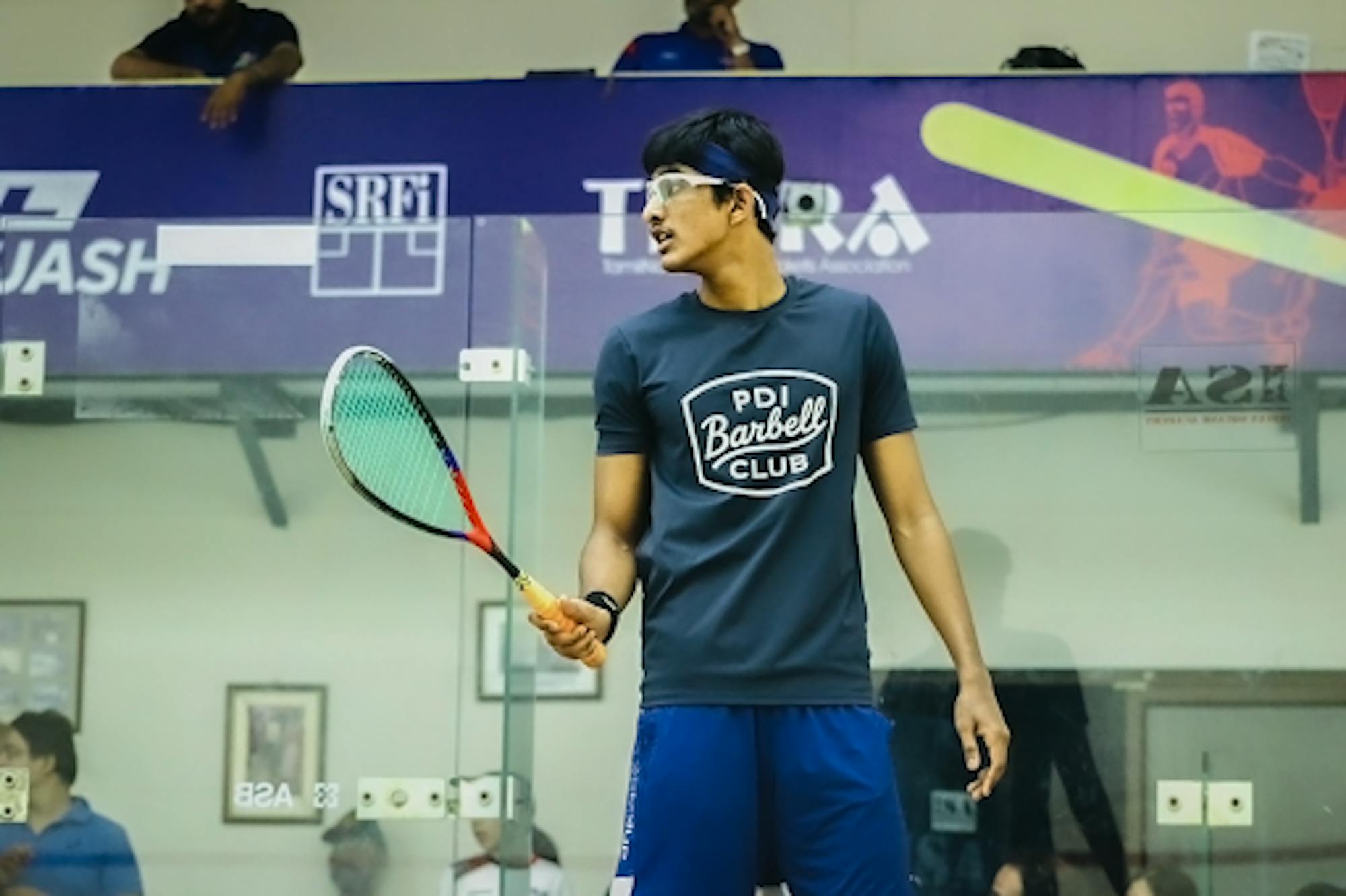
Starting at the age of 6½, Rachit Shah has been playing squash. He said his introduction to the sport was through his family.
“I was really energetic as a child, so my parents wanted me to do something productive with that energy,” Shah said. “They just made me start squash.”
Growing up in Mumbai, India, Shah attended Utpal Shanghvi Global School. In his family, Shah said both he and his sister play squash, but the only other person who played the sport before him was his mother’s cousin.
Before leaving for Tufts University, Shah was ranked No. 2 in India for squash. As an older brother, he said he tries to support his sister when his schedule allows it.
“I usually try to mentor her whenever I’m free,” Shah said. “I had a break ... after my senior year to freshman year of college, so I tried to play with her every morning, [gave] her some tips and [tried] to get [her] better at squash.”
Shah’s first coach was Shashi Pandey, who started coaching him when he was 6½ years old. He played with Pandey until he left India for college. Shah said his introduction to the competitive world of squash was at a young age.
“I started to compete at the age of seven, got really badly beaten in my first tournament, and it only went up from there,” Shah said.
After losing his first match, Shah said his mindset adapted.
“I lost 11–0 ... the first match I played, and that was a thing, that ‘I can’t lose anymore,’” Shah said. “I [had] to get better, so I just put in the hours, got better and the next year I won the Indian Junior Open.”
His first win at the Indian Junior Open was when he was 9 years old, and he said he competed against kids ages “anything to 11.”
“The day I won the tournament, the next day I went back, and my coach made me run 100 coach sprints,” Shah said. “He’s like, ‘You go back to training,’ because I was a bit happy and all. He’s like, ‘No, you focus again,’ because the nationals were coming up.”
As his popularity grew, Shah said his parents and other squash players taught him the importance of not letting ego impact his daily life.
“My parents always taught me to stay grounded,” Shah said. “My seniors in the squash circuit, when I was under 11, they were under-19 national champions and they always played with me, and they never had any ego.”
Continuing his competitive journey, Shah said he was invited to compete in the Asian Junior Trials in India but suffered an injury.
“I got a call at the age of 14 to play for India at the Asian Juniors,” Shah said. “I had a back spasm, and then that led to an asthmatic attack, so I couldn’t do that ... But the very next year, I got a call again, and I actually played the Asian Junior Open.”
Despite his success in the sport, Shah said when he began playing he wanted to quit squash.
“When I was small, I used to lose everything,” Shah said. “There was maybe half a year where my parents had to push me, and from there I just took it on my own that I like this thing and I’m gonna do it whatever happens.”
At the start of his competitive journey, Shah said he struggled with performance stress.
“I used to get really nervous,” Shah said. “[I] used to not perform under pressure, but as I grew older, I played so many more tournaments.”
As he continued to play, Shah said his fear began to fade away.
“I think I thrive under pressure,” Shah said. “When the pressure is high, I play better automatically, and ... I’ve overcome that nervousness and the feeling of pressure. It’s still there, but it’s like much less.”
As his talent grew, Shah said his mindset about losing adapted.
“I learned throughout ... that as long as I’m happy, my coach is happy, my parents are happy, my friends are happy. It’s all good.”
Shah said his high school years consisted of waking up at 5:30 a.m. to play squash, running to school, doing homework and then evenings filled with squash from 4 p.m. to 7 p.m.
Reflecting on balancing academics and squash, Shah said many days he had to miss school to compete.
“My attendance at school [was] really bad because I [was] always traveling for tournaments, traveling for training, coming late to school because I [had] training in the morning, leaving early from school because I [had] training after school,” Shah said.
Before games, Shah said he follows a tight schedule prior to training and a match so his “body doesn’t feel a change” between training and matches. The schedule consists of listening to music, stretching, mobility, warm-ups and conversation with fellow squash players.
During his senior year of high school, Shah said he was offered the opportunity to speak at a TEDx event hosted at his high school.
“Someone from my high school approached me saying, ‘We’re hosting a TEDx event in our high school. Would you like to be our guest speaker?’” Shah said. “They just said, ‘Just speak your heart out, say whatever you want and no one knows you better than you.’ So I just spoke about it, my journey, my life.”
Shah said his experience playing squash in front of many people helped him to feel confident going into the TEDx Speech.
“When I gave my TEDx speech, there were like 300 people in front of me. I was just talking, and I didn’t feel a thing because playing in front of 300 people is much harder than talking in front of 300 people,” Shah said.
Alongside playing squash at Tufts, Shah and his younger sister have been invited to play at the U.S. Open. Shah said the invitation can help his career move forward.
“People from all over the world come to play that event,” Shah said. “Doing well in that event is probably going to mean the world to me.”
“[Squash]’s a really niche sport,” Shah said. “For me, it’s what got me to where I am today. It’s part of who I am today.”