It opens with a cold blue spotlight on Joe Keller’s face. A young boy plays with a toy plane, set to haunting vocals. Joe’s eyes follow the boy’s path, and so do ours. It’s a simple but powerful choice from director Scott Edmiston to foreground the play; as the story unfolds, this pre-scene becomes increasingly, painfully poignant.
“All My Sons” is a play written by Arthur Miller (of “The Crucible” and “Death of a Salesman” fame), and it was first performed in 1947. Nearly 80 years later, Edmiston and the Lyric Stage Company of Boston have brought the play to the Back Bay neighborhood. Staging “All My Sons” gives us a glimpse into America’s history, reminding us that the past is not so different from the present.
The story is set in the summer of 1947, where American domestic life is finding its footing again after the end of World War II. Joe (Bill Mootos) and Kate Keller (Laura Marie Duncan) have two sons who went to war, but only one of them, Chris (Mark Souza), has returned home. Their other son, Larry, is missing in action, and Kate is the only one who is convinced he is still alive.
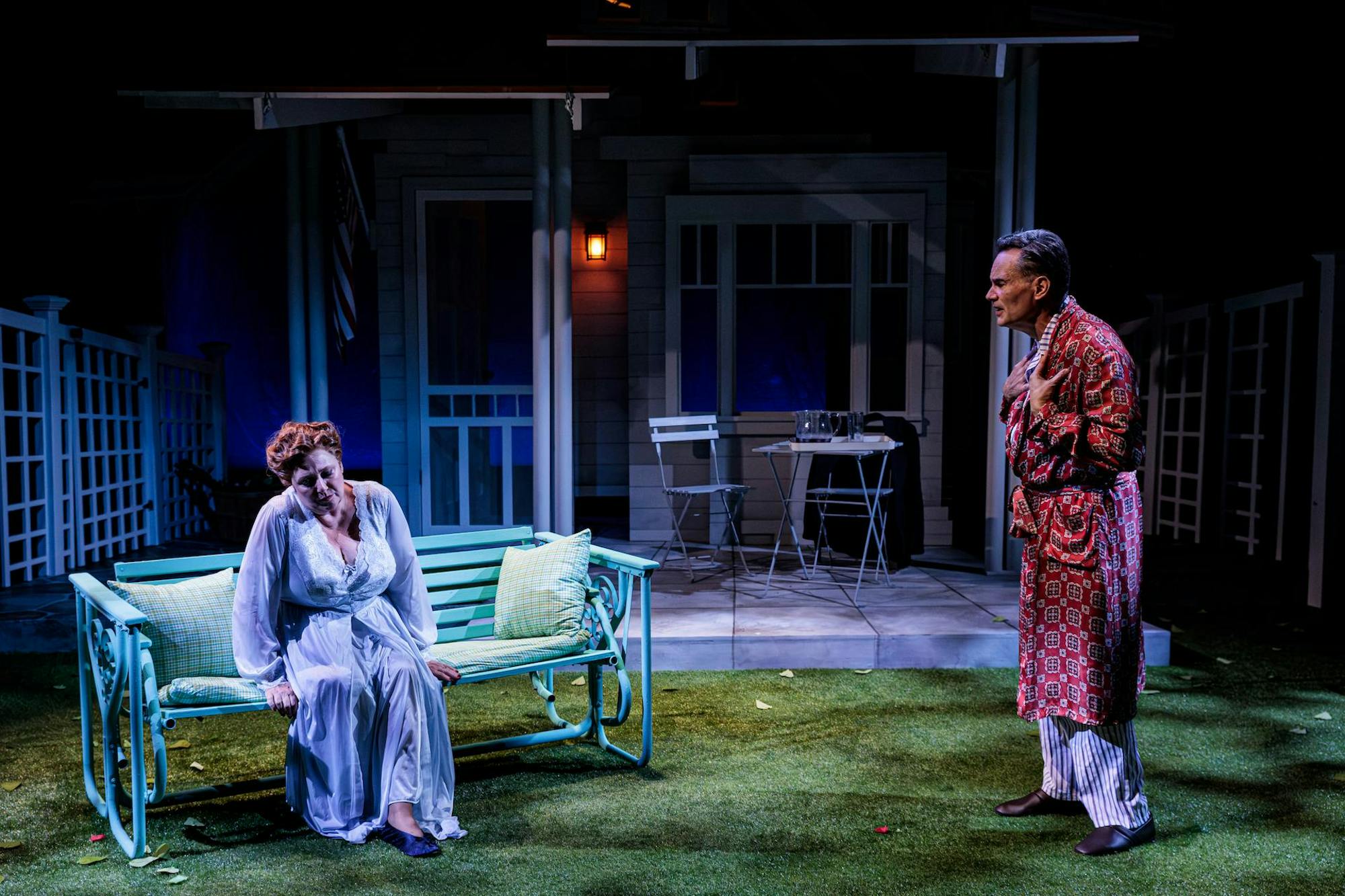
Everything unfolds in the Keller family’s backyard, which has been crafted by scenic designer Janie E. Howland. The facade of the house appears grounded in reality, but the fractured, hanging roof pieces above add a surreal edge. Meanwhile, green grass and cheerful pastel lawn furniture seem to foreshadow the trouble in paradise that is about to unfold. The show is performed on a thrust stage — that is, with seating on three sides — which physically immerses the audience in the scene.
The cast quickly settles into the rhythms of “All My Sons’” neighborly banter, their chemistry light and easy. But the peace among the characters always feels quietly tenuous — something is never quite right. The effect is delightfully uncanny.
Joe, the patriarch of the Keller family, is a business man whose factory made parts for planes during the war. He is a variant of the American everyman — joking, a little bumbling and harmless. We are thus welcomed to project ourselves onto him. Mootos brings him convincingly to life. Meanwhile, Kate Keller is the archetypal doting mother, but with a perpetually anxious energy. Duncan’s performance transforms Kate into desperation personified, and it’s a standout throughout the entire show. Her hope is what fuels the story’s suspense and tragedy.
The return of Ann Deever (Josephine Moshiri Elwood) to the Keller home is what throws everything off kilter. Ann is the daughter of Steve Deever, Joe’s former business partner who is now in prison for shipping off cracked cylinders to the Air Force that resulted in the deaths of 21 pilots. Ann was also Larry’s sweetheart at the time of his disappearance. Now, scandalously, she and Chris have been exchanging letters — and Chris is planning to propose to her. Wide-eyed and perfectly poised, Elwood’s performance gives the Kellers’ nervous energy something to cling to and bounce off.
“All My Sons” is best when it stews in its own silence. Oleg Smirnov’s sound design is pleasant during scene transitions, but at other times distracting. Specifically, the music that plays over an emotional moment where Kate is speaking to herself is unnecessary. The monologues shine when they are left to the actors.
The second act is where the play really picks up speed. Ann’s brother George (Quinton Kappel) enters the picture, threatening the Keller family’s status quo. He claims that Joe is the one solely responsible for the crime that Steve is in prison for. Kappel’s intense physicality and booming voice makes George a terrifying vengeful figure, contrasting starkly with Mootos’ rather sheepish Joe.
The play crescendoes in the third act, with the revelation that Joe knowingly shipped out the faulty cylinders. Here, Souza shines as Chris — he takes us seamlessly from shock to anger to hatred. The father-son dynamic between Joe and Chris is at its most compelling, distorted beyond recognition. The denial and despair in each of Mootos’ line deliveries is visceral.
Ann then reveals a letter she received from Larry during the war, in which he tells her that he is committing suicide out of the shame and grief he feels about his father’s actions (or lack thereof). It’s the most devastating turn in the show, for Larry was the Schrödinger’s cat that everything hinged on, and now the box has been opened. Souza’s, Mootos’ and Duncan’s performances are perfectly unhinged.
Joe attempts suicide offstage, and the silence that follows the gunshot sound effect is the most chilling and effective in the entire play. Chris and Kate embrace, with the same cold spotlight that opened on Joe bringing everything full circle. Then, the darkness closes in, and it’s this that we’re left with — and that we share.
“All My Sons” runs at the Lyric Stage now through Oct. 25.