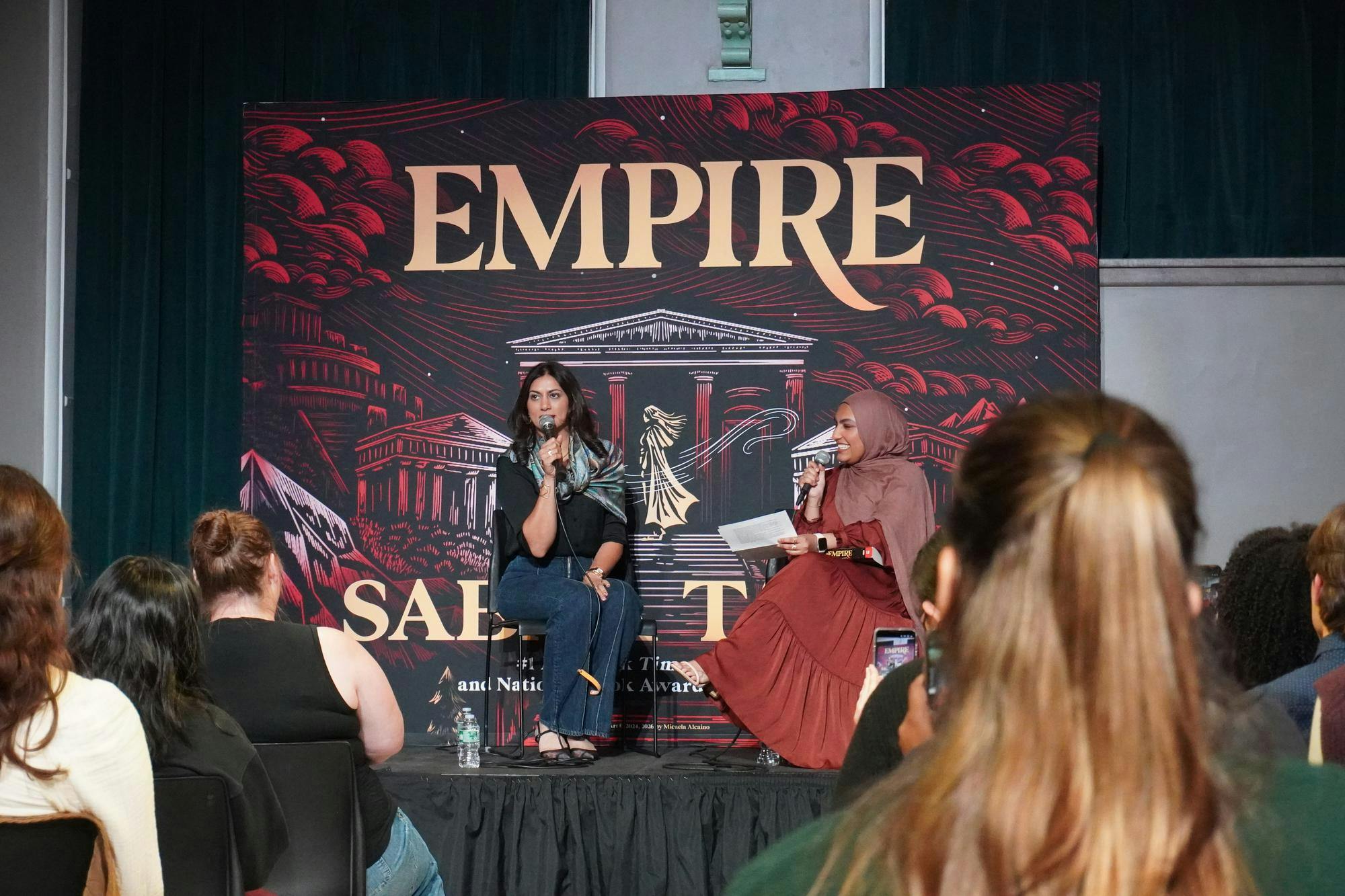
Narrative Bookshop hosted author Sabaa Tahir on Wednesday, Sept. 23, to celebrate her new novel, “Empire.” As part of her national book tour, Tahir joined Azanta Thakur in conversation at the Multicultural Arts Center. Tahir is a young-adult author best known for her New York Times bestselling fantasy series, “An Ember in the Ashes.” With support from the Asian American Center at Tufts, 10 students attended Tahir’s Cambridge book tour stop for free.
Tahir grew up in a small town in California’s Mojave Desert, where her family ran an 18-room motel. She spent most of her childhood reading fantasy novels but stopped writing fantasy in college to focus on journalism. While working at The Washington Post, she read a story about Kashmiri women whose families were taken by the military. The story was one of the things that inspired her to return to fantasy and write “An Ember in the Ashes.”
Tahir’s fantasy series reflects the kind of storytelling that inspired the founding of Narrative Bookshop. Owner Mila Hossain opened the independent bookstore to showcase marginalized voices and identities through the store’s curated selection of books. Hossain began the book talk by recalling how she first read Tahir’s work during the COVID-19 pandemic. During this difficult time, she found comfort in the South Asian author and in seeing herself represented in the books she read. Hossain set out to build a bookstore that displays a range of experiences and identities to amplify diverse voices in literature as Tahir’s writing does.
With “Empire,” Tahir concludes the fantasy duology she began with “Heir.” At the talk, she said readers can expect “mayhem, pain, some kissing and a cat.” The story returns to the collapsing Martial Empire, where Crown Prince Quil Farrar and his aunt, Empress Helene, keep losing troops to the Kegari horde. Quil continues to grieve Sirsha Westering, whom he loves and who vanished months ago. Meanwhile, Sirsha is bound to Div, an ancient evil that will not release her until she uncovers its past and confronts her own horrors. The third protagonist, Cero, a former lieutenant to the Kegari leader, must decide whether his people can build a future or will keep repeating the same cycle of violence. Though “Empire” takes place in a fantasy world, it echoes universal themes: the devastation of war, the courage of rebellion and the haunting return of buried pasts.
When asked what inspired the “Heir” and “Empire” duology, Tahir said she drew partly on her frustrations with the real world, especially the United States. She noted that the country expanded under the idea of manifest destiny, yet its history is tied to disease, genocide and slavery. That past still haunts the nation today, much like the world of “Heir” and “Empire” haunts its characters.
On the subject of villains, Tahir said her sympathy for them shapes how she writes her antagonists. She is invested in her villains’ desires and stories as much as she is in those of her protagonists. Tahir mentioned that she wants the antagonists to feel real because they reflect the world, pointing to how Islamophobia has pushed a narrative casting people who look like her as villains. “People like you and me are the villains,” she said. Seeming like a villain, she added, does not make someone a villain. Nonetheless, she acknowledged that some villains are simply cruel people who lash out at the world in anger, which also mirrors reality.
On what she has learned about herself as a writer, Tahir said, “Storytelling is the most powerful force on earth. … We’re not voting a president for his resume, we’re voting because of his story.” She stated that the war with Iran is a current example of certain narratives being pushed to advance a conflict. Historically, people in India, Pakistan and other colonized countries have used storytelling to take back control from colonizing powers. Tahir said people should always question warped narratives and the people who create them because “the ones who pay for those stories are rarely the storytellers. More often, they are people with no power, such as children.”
As for the ending of “Heir,” Tahir said, “I believe in hopeful endings, but hopeful endings aren’t always happy endings.” Readers can expect a similar tone in her next project, an adult fantasy novel she has just begun pitching. The novel follows a country boy who wants to change the world and a girl who will do anything for revenge.
The night concluded with an audience Q&A. Tahir said the question she most hoped to hear was: “What is your favorite line from ‘Empire’”? She responded by looking out for the line “Walk with me into the dark,” leaving the meaning for readers to interpret. The line was a fitting close to an evening on whether the dark deserves to be villainized, the power of narratives and excavating the past that haunts us.