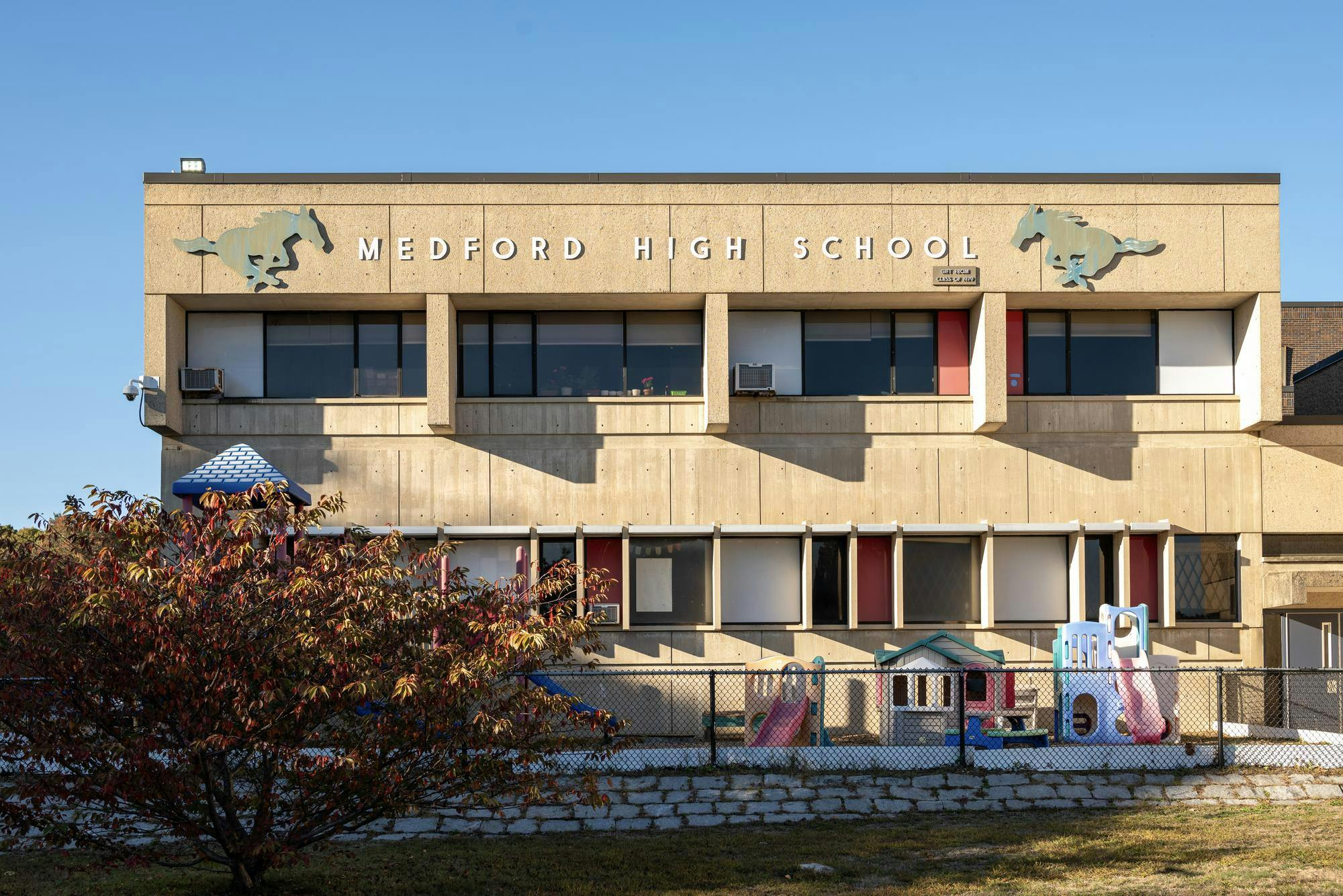
The Medford High School renovation project, launched in December 2023 after an invitation from the Massachusetts School Building Authority, has been in the “Schematic Design” phase since August 2026 as the city works to secure funding for the costly project.
Jenny Graham, chair of the Medford School Committee and the Medford Comprehensive High School Building Committee, gave some insight into the project in an interview with the Daily.
“When you start talking about a building as big as Medford High is, and you start talking about the realities of school construction … all of the numbers are surprising. It’s like, whoa, this is going to cost a lot of money,” Graham said.
The project’s total cost is currently estimated at nearly $700 million, which is roughly $150 million less than earlier design-phase estimates. Most of the savings came from changes to the planned heating and cooling system, which was shifted from geothermal to an all-electric air-source heat pump system, which Graham said was “most economical.” Numerous cuts to the building’s proposed space also lowered the cost.
Funding for the project will be split between the MSBA and the city. The MSBA will pay for a portion of the project, determined by the organization’s funding formula and previously established per-square-foot caps. The rest of the funding is “what will be left for Medford,” Graham said.
Deliberations on how Medford will finance its share of the funding continue. One possibility is that the city will pay a portion of the loan. However, the city does not intend to borrow a large sum of money for the project all at once due to concerns about not using all the funds for several years.
The city is in the process of forming a 501(c)(3) to solicit donors to support the parts of the project that the MSBA will not fund. The city’s finance team is also discussing the details of a debt exclusion, which allows the city to increase tax levies above their normal limits in order to pay off the project.
“When you look across communities, most communities do a debt exclusion,” Graham said. “Many fewer have the money in their operating budget that they could support the payback of the loan, and so they don’t need to do that.”
Mayor Breanna Lungo-Koehn, the ex officio chair of the School Committee, said that the current proposed school design was one of the more “reasonably priced options.” She mentioned that the debt exclusion — which will determine the monthly and yearly tax bill increases — will be based on how much the MSBA will reimburse the city. The tax increases will be gradual and based on the loan borrowed over the first five years of implementation.
Lungo-Koehn said that while she was concerned about the impact of the project’s cost on Medford taxpayers, she was hopeful that progress has been made in reducing expenses.
Voters will decide in June of next year whether to implement the debt exclusion. School Committee member Mike Mastrobuoni outlined concerns that voters may not approve the debt exclusion.
“If Medford voters decide not to approve a debt exclusion, the City would not have the ability to pay for this project under the current financial outlook. The City and School District would then have to determine what comes next,” Mastrobuoni wrote in an email to the Daily. “A failed debt exclusion would not mean that there is a cheaper alternative. In fact, it would most likely cost the city around as much to renovate the existing building as it would otherwise build new.”
The Medford School Committee will receive a more detailed cost estimate in the winter. Lungo-Koehn reiterated that the tax increase estimate is still largely dependent on the reimbursement provided by the MSBA. Conversations about the reimbursement are ongoing, and the project’s current estimate is not final.