
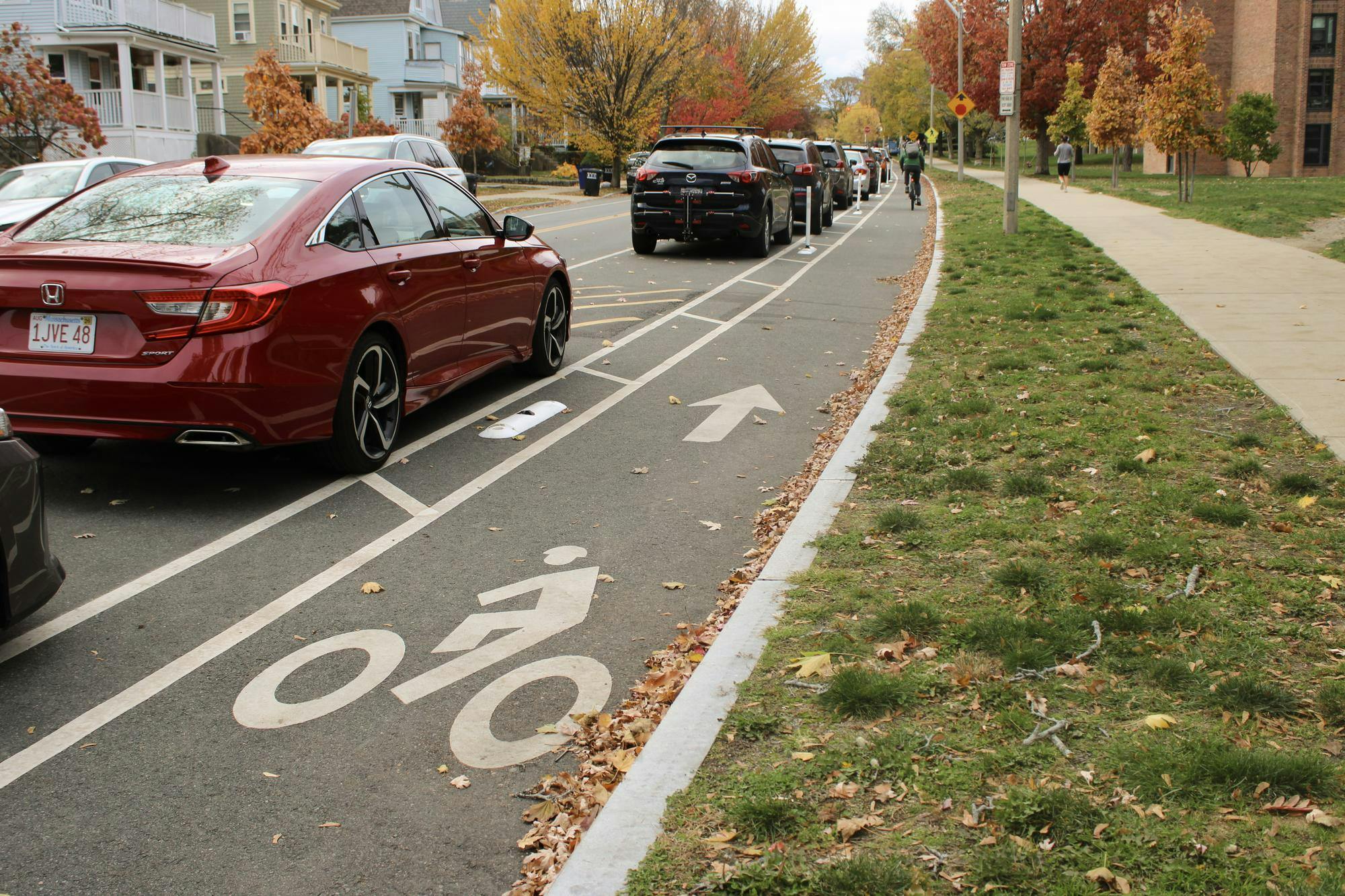
The Somerville City Council approved more than $250,000 on Sept. 24 for the city’s Vision Zero traffic safety program, drawing on fees collected from transportation companies like Uber and Lyft. The appropriation comes as Somerville’s annual report — as required by the Safe Streets Ordinance — acknowledges that the protected bicycle lane network the city is obligated to complete by 2030 will take longer than that to build.
Somerville has not recorded a traffic fatality since 2022, a record that has drawn national attention. In an email to the Daily, Grace Munns, Somerville’s deputy director of communications, called the milestone “encouraging” but said it “requires continued work to sustain.”
The money will pay for design and engineering on three projects the city expects to advance in 2027, according to Brad Rawson, Somerville’s director of transportation and infrastructure.
The first, the Broadway-Magoun Reconstruction, will rebuild street and sidewalk infrastructure on Broadway roughly between Cedar and Central streets, with construction beginning in 2027 and finishing in 2028. The second and third are quick-build projects installing separated bicycle facilities on Somerville Avenue, as well as on Washington Street. Both are scheduled to begin and finish in 2027.
Rawson wrote in an email to the Daily that under the city’s standard delivery model, in-house staff lead community engagement and prepare conceptual designs, while outside consultants produce advanced and final designs. The appropriation supports that later stage of work.
According to Munns, the funding supplements the Vision Zero budget, which also draws on the city’s annual operating budget, long-term capital funding and state and federal grants. She wrote that safety improvements are coordinated alongside utility work and street resurfacing.
Vision Zero is an international framework that cities may opt into, committing to eliminate traffic deaths and serious injuries. Somerville committed to the framework in September 2017.
Ward 3 Councilor Ben Ewen-Campen, who serves as the council’s liaison to the Pedestrian and Transit Advisory Committee, said the approach reframes what streets are for.
“Traffic deaths are preventable. Traffic deaths are public health emergencies and should be treated as such,” Ewen-Campen said.
Somerville codified their commitment to reducing traffic deaths in the Safe Streets Ordinance, adopted in June 2024. The ordinance requires the city to install all protected bike lanes in the Bicycle Network Plan’s priority network — 28.79 miles as currently mapped — by Dec. 31, 2030.
The city’s 2026 Safe Streets Ordinance Annual Report lists 14.83 of those miles as remaining to be built between 2028 and 2030, and notes in several places that staff resources, engagement timelines and project funding will require extending the timeline beyond 2030. The ordinance allows the city a one-year extension, which it must exercise by March 1, 2029.
Ewen-Campen attributed the delay to rising municipal expenditures rather than any retreat from the policy, expressing confidence that the network will be completed.
“We were not foreseeing that there would be massive interest rate spikes, and that the Winter Hill School would need to be rebuilt,” he said. “If I thought that this slowdown was for political reasons, or for cowardice, then you would hear me saying that clearly.”
Alessandra Seiter, who chairs the Pedestrian and Transit Advisory Committee, offered a similar account and pointed to the size of the staff carrying out the work.
“They are incredible public servants, but there are only eight of them,” Seiter said of the Mobility Division. “The people who work in Mobility are kind of maxed out.”
Seiter, who previously sat on the city’s Municipal Compensation Advisory Board, said that the constraint is not based around pay. She said the compensation study reviewed during her term established a $65,000 baseline for city employees and that some Mobility staff have worked there for more than a decade.
“There is a certain amount of stability in those roles. I think it’s more so that it is difficult to add positions,” Seiter said.
The city says it is meeting its yearly target for new separated bicycle facilities. In the 2026 annual report, Somerville met the annual benchmark of 3.26 miles of separated facilities specified in the Bicycle Network Plan and the Safe Streets Ordinance. Munns said 3.2 miles are planned for 2026.
According to Seiter, public response to the roughly dozen engagement meetings the committee holds each year has been broadly positive, with residents asking for more traffic calming and faster progress.
Criticism, she mentioned, tends to focus on parking spaces removed for sidewalk bumpouts or floating bus stops.
“We also hear from seniors who I think experience a feeling of unsafety when they are using the sidewalks alongside people who are biking or using scooters,” Seiter said.
Seiter said she supports the ride-hail fees — a flat $0.20 rate on all rideshares — funding the work.
“Most folks who would be taking an Uber or a Lyft ride probably have money to spare for a flat fee or a percentage of their ride to go towards making streets safer for everyone,” Seiter said.



