
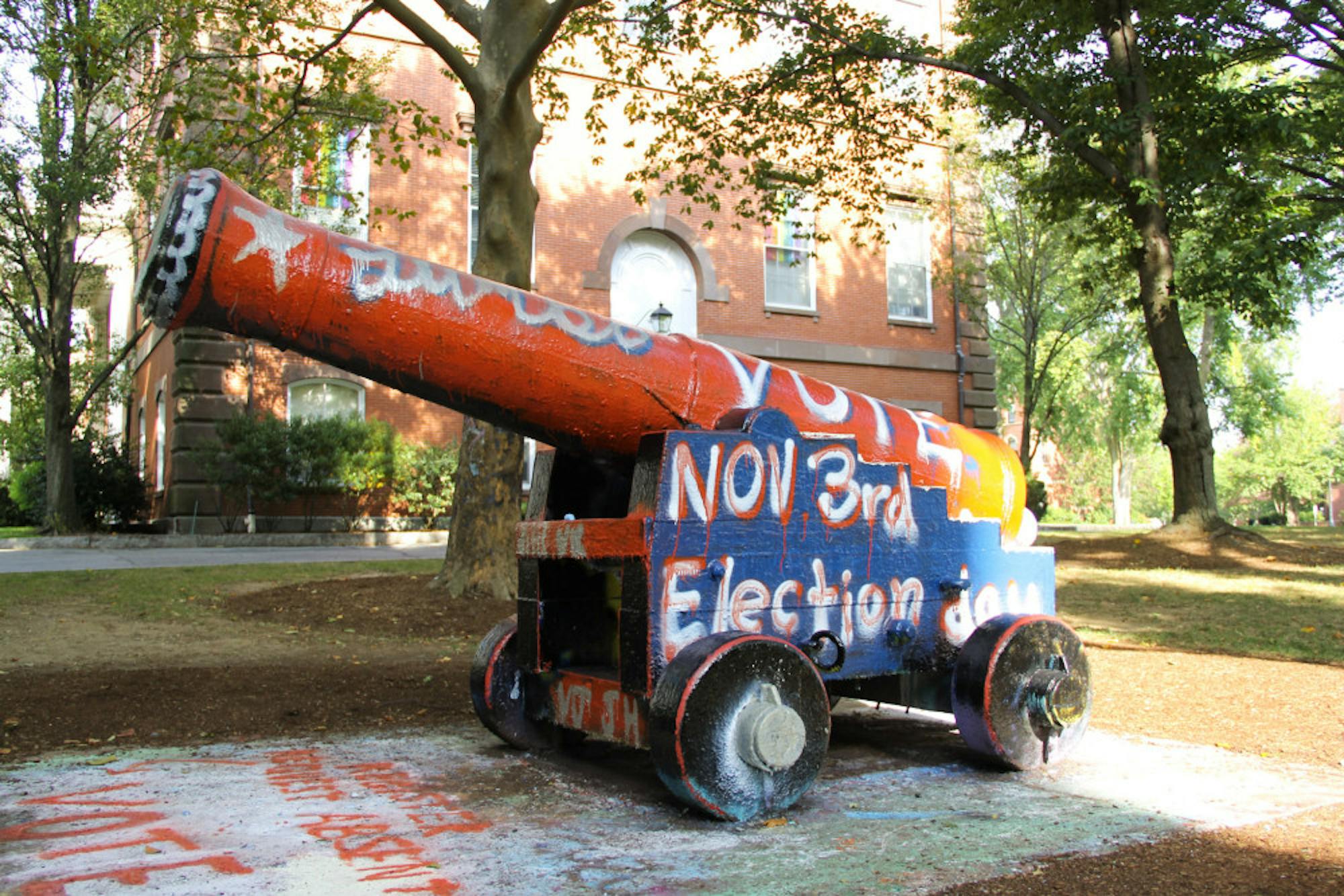
Two of the record-tying nine ballot initiatives that Massachusetts voters will consider this November could change how the state conducts its elections.
Question 3 would replace Massachusetts state primaries with a single nonpartisan jungle primary in which the top two vote-getters advance to the general election. Question 4 would allow same-day voter registration, eliminating the current 10-day registration deadline.
According to Evan Horowitz, executive director of Tufts’ Center for State Policy Analysis and a research professor, the two questions differ in scale.
“Question 3 will change the way we run elections. It will change who gets into office,” he said. On Question 4, Horwitz said, “the scale of potential impact is much, much smaller.”
Currently, Massachusetts uses separate party primaries, in which the winners of the Democratic and Republican primaries face off in the general election. Under Question 3, candidates from all parties would compete in an open primary, meaning the two candidates competing in future general elections could come from the same party.
Rishabh Handa, political director of the Tufts Democrats, supports Question 3, saying that a top-two primary includes the perspectives of Republican voters in the candidate selection process in a blue state like Massachusetts and “encourages candidates to reach across the aisle.” He added that a top-two primary amplifies the voices of third parties and independents within a two-party system.
Horowitz argued that Question 3 would make general elections in Massachusetts more competitive because of the possibility of two Democrats competing.
He added that the change could also bring more money into politics because candidates would need to fund two competitive election campaigns.
In contrast, Eitan Hersh, professor of political science, believes that Question 3’s impact will be limited.
“Even in Massachusetts, which is a very Democratic state, you still have a good chunk of people who are Republicans,” he said. “The top two vote-getters would often be the Democrat and Republican.”
However, he added that in particularly progressive districts where both nominees would likely be Democrats, moderate candidates could see a minor advantage should the initiative pass.
Both Hersh and Horowitz believe that Question 3 would result in a loss of party power. Under the current partisan primary system, parties have wide control over the rules and administration of their primary. A top-two primary election, however, would be state-controlled.
Parties would maintain some influence in the form of endorsements, but the extent of that influence is not always evident.
“It’s not clear how big a deal that is,” Horowitz said about party endorsements. “How much do voters trust a party to tell them how to vote?”
Question 4 could also affect the outcome of general elections. Currently, Massachusetts voters must register at least 10 days before an election. Question 4, which was petitioned for by Secretary of the Commonwealth William Galvin, alongside nine other citizens, would allow voters to register on election night.
24 states and Washington, D.C., already allow for same-day voter registration, which is thought by some to increase participation in elections.
“There’s evidence that it increases voter turnout,” Hersh, who has testified in the Massachusetts State House in support of same-day registration, said.
The impact of implementing same-day voter registration on turnout may be modest, though. Massachusetts has already implemented automatic voter registration, which has resulted in high voter registration rates.
“There might conceivably be some small increase in turnout in elections if we introduce election day voter registration, but I would expect it to be very small,” Horowitz said.
Still, same-day voter registration has the potential to increase turnout among young people, who move frequently and thus often need to update their registration.
“In certain districts where students make up a larger share of the population, that can make a difference,” Hersh said.
Both Hersh and Horowitz felt confident that same-day registration would be straightforward to implement and had little concern about same-day registration causing more fraud.
Question 4 seems likely to pass. 59% of respondents to a Sept. 24 University of New Hampshire poll said they would vote “yes,” compared to 38% voting “no” and 4% voting undecided.
“I definitely think that a lot of students … are pretty big in favor of having same-day registration,” Handa said.
Question 3, on the other hand, appears to be one of the most contested measures on the ballot. In the same poll, 41% responded “yes,” with 39% responding “no” and 19% voting undecided.
Massachusetts voters will have the final say in the general election, which is slated for Nov. 3.
Zahra Brady contributed reporting.



