The Art of Good Soup: A souposium on good form
By Ellie Lester and Cole Reese | November 16Nevada. Long ‘a’ or short ‘a’? Please get back to us with your phonetic spelling. It’s political.
Nevada. Long ‘a’ or short ‘a’? Please get back to us with your phonetic spelling. It’s political.
Okay, everyone, it’s time to get real. When I first applied to be a columnist for The Tufts Daily Arts section way back in the fall of 2021, I had three big ideas: musicals, books and (obviously) K-pop. When asked to choose one of the three, I immediately knew my decision would be K-pop. I love musicals, but I’ve never been to Broadway. I love books, but I was worried about fitting all my love for even a single book into 500 words.
Remakes of classic movies and TV shows are everywhere these days. “Reboot” (2022–), a meta new comedy series that just wrapped up its first season on Hulu, makes fun of this trend by taking viewers behind the scenes of the revival of a fictional sitcom. On “Reboot,” the original cast of the popular comedy series “Step Right Up” is reunited after nearly two decades when up-and-coming writer Hannah Korman (Rachel Bloom) pitches a reboot to Hulu, hoping to take the show in a new direction.
Known to most as Severus Snape, Alan Rickman was a highly revered British actor, both on screen and on stage. Throughout his career, Rickman starred in many critically acclaimed films including “Die Hard” (1988) and “Sense and Sensibility” (1995). His decades-long career resulted in a British Academy Film Award, Golden Globe, Primetime Emmy, Screen Actors Guild Award, and plenty more wins and nominations for his dozens of projects.
The “Funny Girl” casting debacle is likely the biggest headline-grabbing scandal to hit Broadway in the past 10 years. For those living under a rock (or without Twitter), here’s your brief crash course. Back in 2014, at the peak of the public fascination with “Glee” (2009–15), show creator Ryan Murphy purchased the rights to a possible Broadway revival of the Barbra Streisand classic “Funny Girl” (1968). But, perhaps thinking the world had seen enough of Lea Michele singing the show’s hits, Murphy held off from putting up the show. Then, in 2020, Glee co-star Samantha Ware accused Michele of racist bullying on set back in their “Glee” days. This led to a flurry of accusations and public comments, leaving Michele’s reputation undeniably stained. In 2021, it was announced that Beanie Feldstein would headline a Broadway revival of “Funny Girl.” After heart-wrenching reviews and disturbingly shrill promotional footage, the relationship between Feldstein and the show’s producers quickly became tense. With Feldstein taking an early leave from the show, her replacement, none other than Lea Michele herself just two years after her public cancellation, was quick to cause a stir.
Edward Underhill’s debut novel, “Always the Almost,” is a heartfelt and emotional young adult contemporary romance releasing next year from Macmillan. Midwestern pianist and high schooler Miles Jacobson has just come out as trans — the result of which is a strain on his relationship with his parents and his boyfriend, Shane, ending things with him. And while his friends are accepting of him, ever since Miles and Shane began dating, he’s felt out of place. It doesn’t help, either, that his new piano teacher keeps telling Miles that he needs to figure out who he is. Desperate for a win, Miles resolves to get back together with his ex and beat his stuck-up rival at an upcoming piano competition. But when Miles meets Eric, a new boy who’s just moved into their small town, everything changes. Asthe two bond over their art — Eric with his cartoons and Miles with his music — and go from friends to more, Miles begins to question who he is, what he truly wants, and why he’s never felt like he’s enough for anyone, especially himself.
For much of the 20th century, LifeMagazine conquered mass media as the primary visual source for current events. From 1936 to 1972, the magazine presented the public with carefully crafted images that captured real-world social and political narratives. Henry Luce, the publication’s founder, was able to expose readers to a wide variety of images outside of their immediate community, shaping discussions about contemporary issues in the process. As the Museum of Fine Arts puts it in its new exhibit, “with its visually revolutionary brand of storytelling, Life fundamentally shaped how its readers understood photography and how they experienced and remembered events.”
Listen up, nerds. This is serious business … we need ANSWERS.
One of the newest movies on Netflix, "The School for Good and Evil," is based onSoman Chainani's 2013 novel of the same name. Have you ever wondered where fairy tales like Cinderella and Jack and the Beanstalk come from? Two best friends, Sophie and Agatha of Gavaldon, have long used them to escape their mundane lives. Sophie dreams of a future where she is a princess, but Agatha just wants her best friend to stay by her side while she endures daily harassment as the daughter of the town's "witch." Though they are extremely different, their friendship remains strong, at least until magic joins the equation. The rumored School for Good and Evil enters their lives, taking them away from their homes and into an environment where the rules don't always make sense. Will their friendship survive this school of heroes and villains or will they face consequences far more dire than bad blood as the semester continues?
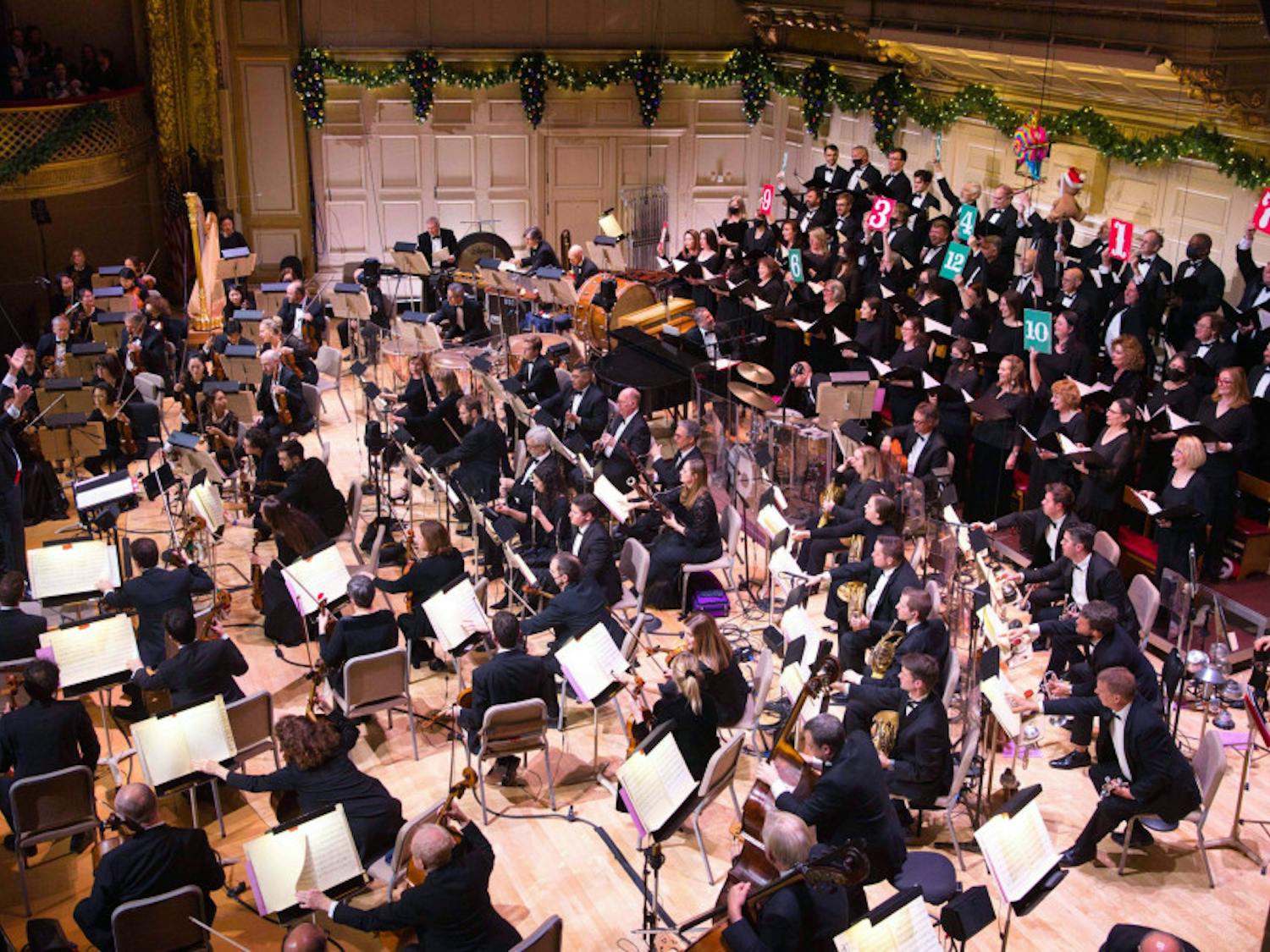
On Nov. 3 the Boston Symphony Orchestra showcased their third and final program that they will be performing on their week-long tour of Japan. The program consisted of Caroline Shaw’s “Punctum” for string orchestra, Mozart’s “Symphony No. 40” and Richard Strauss’ “An Alpine Symphony.” In addition to these pieces, the BSO is taking the past two weeks of performances on the road. Between Mahler’s “Symphony No. 6,” Shostakovich’s “Symphony No. 5” and now Strauss’ “An Alpine Symphony,” the consistent theme behind their Japan tour is gargantuan catharsis that showcases the orchestra's virtuosity.
Today we take a break from our regularly scheduled programming of judging specific Met Galas, and instead choose to rate one specific person’s outfits in honor of her recent birthday on Nov. 3. Dame Anna Wintour, I wish you the happiest of birthdays; please enjoy a ranking of some of your best Met Gala looks to date.
The premise of “The Masked Singer” (2019–) is fairly simple: A panel of judges attempts to guess the identity of a celebrity contestant who performs in an absurd, extravagant costume, eliminating a contestant each week until there is a winner. Some contestants are talented music artists, such as Natasha Bedingfield, the singer of “Unwritten” (2004) and “Pocketful of Sunshine” (2007), while others are definitely not great singers, but stand out for their hilarious performances — look no further than Wendy Williams’ iconic performance of “Native New Yorker.” This season, with 22 contestants, has many fans of the pop culture phenomenon “Glee” (2009) on the edge of their seats as many think the Harp is Mercedes Jones actress Amber Riley.
Jake Maia Arlow’s debut young adult novel, “How to Excavate a Heart," is a warm and tender lesbian rom-com released Nov. 1 from HarperCollins. A Jewish lesbian, Shani, plans to spend her winter break after her first semester of college studying fish fossils at the Smithsonian National Museum of Natural History, not thinking about her recent breakup with her ex-girlfriend. Things get off to a rough start when she and her mother almost hit a pedestrian while trying to navigate Washington, D.C. roads in the snow, but luckily no one is harmed. Shani’s internship begins; she moves into a house with other college students and an old woman who calls them “doll” and begins getting to know her housemates. So, when she agrees to do one of them a favor and take over their dog-walking gig for a few weeks, she doesn’t think much of it. That is until she comes face to face with May — the girl her mother almost ran over. As Shani finds herself coming to May’s house in order to walk May’s father’s corgi, the two inevitably learn more about each other. Shani comes to find out that May is a Jewish lesbian too, and she’s just as passionate about atmospheric science as Shani is about paleoichthyology. While the two don’t get along at first, they’re forced to spend Christmas Eve together due to inclement weather, and they find themselves growing closer as a result. As Shani finds herself falling for May, she can’t help but worry about the risk of heartbreak in the aftermath of her ex-girlfriend’s harsh rejection.
The final season of “Game of Thrones” (2011-19) was not bad. For all its fumbling and all its bluntness, the way the world last left Westeros was emblematic of the environment that the show and books that inspired it created. In the show’s aftermath, the prequel show “House of the Dragon” (2022) was released in August of this year. Though the prequel seemingly tried to become “the next” “Game of Thrones” or “fix” what the original had wrong at its core, this isn’t the case. Because not only is “House of the Dragon” good, but also it has also effectively resurrected its predecessor’s cultural relevance in an expert display of craft, acting and writing.
Where do we even begin? Like… what?
This week’s K-Weekly will cover a much more serious and heavy topic out of respect for the events that occurred in Seoul on Oct. 29.
We’re currently living through a chill-rock renaissance. That genre title may sound a bit quaint and a bit overblown, but it perfectly encapsulates just where modern rock music is headed. Think of artists like Omar Apollo, Dominic Fike or even Remi Wolf. They use traditional rock tropes but slow them down to create a more calming, smooth vibe. Add in some R&B influences, you’ve got yourself a new genre. And nobody is leading the chill-rock charge like Steve Lacy.
Content warning: This article discusses transphobia.
The Boston Symphony Orchestra’s most recent Oct. 27–30 performance of two fifths: Beethoven's “Piano Concerto No. 5”, and Shostakovich’s “Symphony No. 5,” proved among their best yet. Both pieces delighted in virtuosic furiosity, pianistic virtuosity for the Beethoven and orchestral virtuosity for the Shostakovich, but ultimately the slow movements stole the show with their emotional potency and heart wrenching sincerity.
In the 2000s and 2010s, network sitcoms were some of the biggest shows on television — think “The Office,” (2005–13) “Modern Family” (2009–20) and “The Big Bang Theory” (2007–19). These days, the era of broadcast dominance is in the past as most network comedies have very little to offer compared to their streaming counterparts. That’s why it’s been such a pleasant surprise to see “Abbott Elementary” (2021–), a half-hour sitcom on ABC, emerge as one of the sharpest and funniest comedies of the last few years.