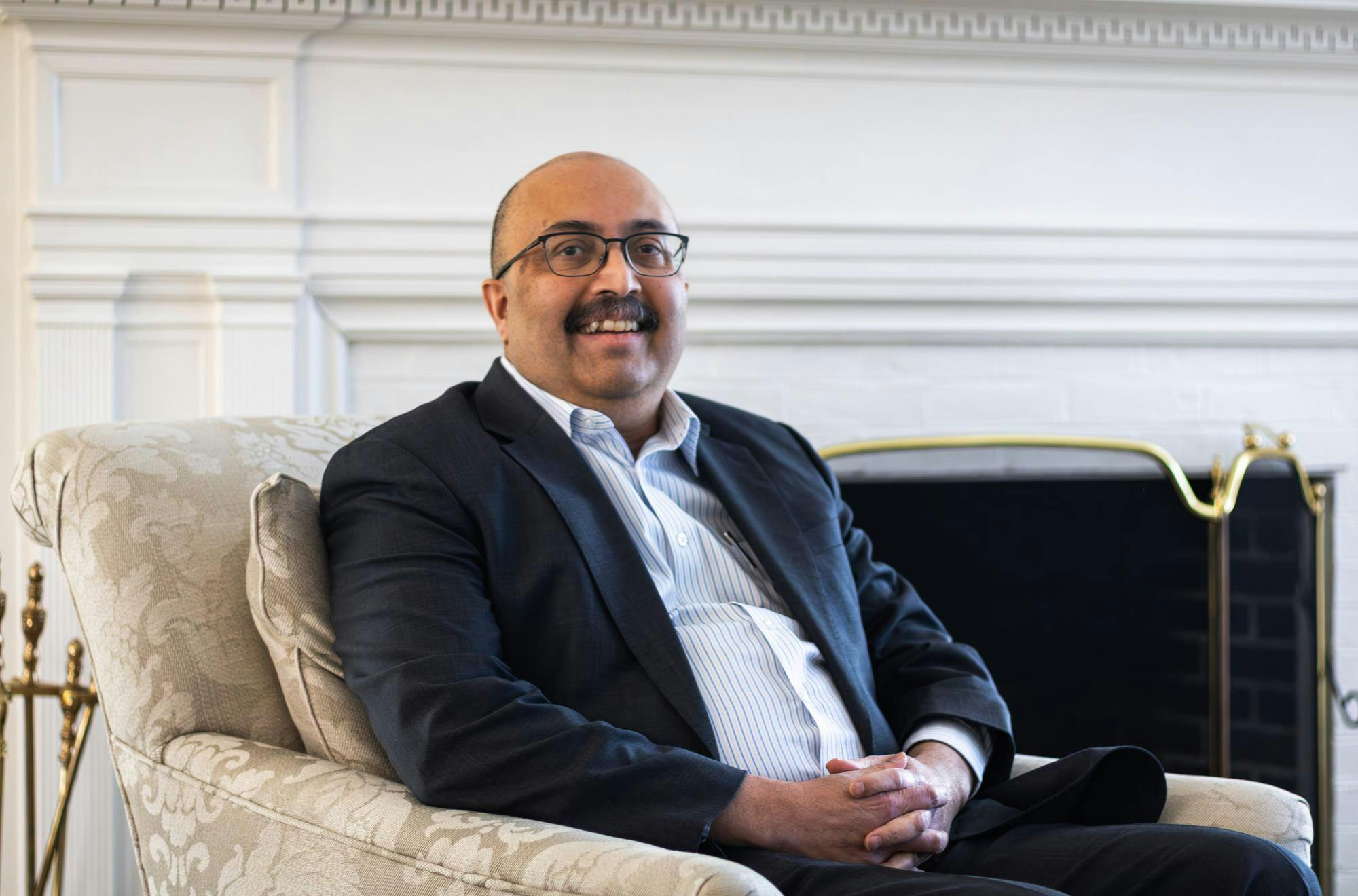
On April 18, the Daily sat down with University President Sunil Kumar to reflect on his second year as Tufts’ president and discuss the shifting state of higher education.
Editor’s note: This interview has been edited for length and clarity.
Tufts Daily (TD): President Kumar, thank you so much for taking the time to sit down with us today and inviting us into your home. We have to ask, do you really live here in Gifford House?
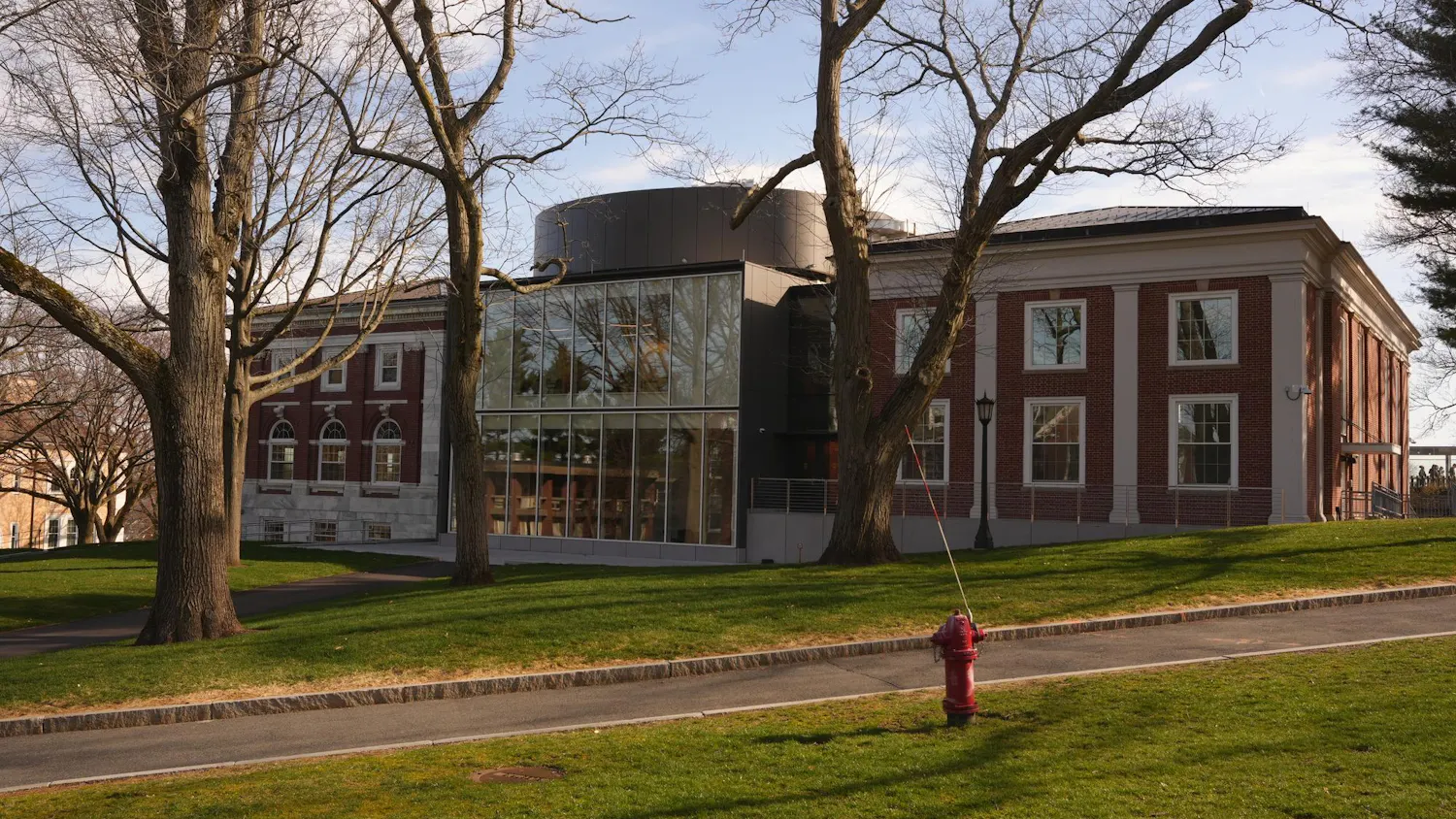
Sunil Kumar (SK): Yeah, of course I do. We are in our backyard all the time. It makes for a very short commute and it puts me in the middle of campus. We like living here. It has some problems — it leaks over there, but other than that, it’s pretty good.
TD: To start out on a positive note, what would you consider your most significant accomplishments as president this year?
SK: The biggest one is the residence hall, which is going to make a huge difference to community on campus. Having 650 juniors and seniors back on campus will be very good — that’s a big achievement. The other one is less visible, but equally important: We raised about $180 million this year, and one-third of that is for financial aid. The economic diversity in the class this year will be significantly higher than last year. The rule of thumb is about $80,000 of parental income per year qualifies for the Federal Pell Grant — we used to be 12% last year, we expect to be 15% this year. That’s a 25% increase from last year’s baseline, and that’s partly funded by all the fundraising we have done.
Two other things we’ll announce, and this is particularly relevant given potential pressures on federal funding, is a private philanthropy investment for a Material Science Institute, and we’re building a new learning center for the Cummings School of Veterinary Medicine.
TD: Last fall, the admissions office reported a decrease in racial diversity for the Class of 2028, which was the first class to be admitted after the Supreme Court’s ruling on affirmative action. Has the university shifted its approach to reaching its diversity goals?
SK: First of all, we comply with the law. What that means is we don’t know the racial and ethnic makeup of the applicant pool of the class until the waitlist is closed. We have done two things to adapt to those laws. The first is putting an emphasis on economic diversity as a way to open our doors more broadly, and we will continue to try and become more affordable. The second is outreach. We do have a national reach, and we need to expand that. In particular, we have to expand in the Midwest, in the South, and from urban to rural settings as well. Those are the two strategies to ensure we can put together a class that represents all the forms of diversity in this country.
TD: We want to move towards what's happening now, and talk about the current landscape of higher education. Currently, college campuses across the nation are facing the threat of losing millions, if not billions, of dollars in federal funding. Do you believe Tufts is facing the same risk, and does the university have a plan in place to respond?
SK: We have already faced some funding cuts. For example, our U.S. Agency for International Development funded projects have evaporated. We have lost about 12 research projects already; the amounts are in the $15–20 million range. We have been able to, with a few exceptions, reabsorb the people involved in those projects or find alternative sources of funding at least temporarily, to make sure that we can keep going. We have not had any, I would say, catastrophic impact of any sort.
The other two federal funding impacts have been on the facilities and administration rates for both the National Institutes of Health and for the U.S. Department of Energy. The NIH one would have cost us roughly $30 million a year. It would have quite a substantial impact on the university’s operations. We were one of the plaintiffs to push back on it in the national lawsuit, and we received a permanent injunction, which allows us time to renegotiate with the government or at least wait to see how the appeals pan out.
Our exposure to Department of Energy grants is not that high, but it still would have had a substantial seven figure impact on us, so we did file a declaration. I don’t want to speculate about future risk, but there is enough to play defense against right now.
TD: Are you in contact with other university presidents and leaders?
SK: Constantly. Next weekend, I’m in Washington, D.C., with the Association of American Universities. This is 70 of the largest research universities in the country. We both learn from each other, as well as do things collectively, like the NIH and Department of Energy lawsuits. The Boston-area university presidents keep in touch and we try to learn from each other.
TD: Have those conversations influenced any of your responses to the impacts of federal funding that have already taken place?
SK: Collective action wherever possible is more impactful than unilateral action. Now, there have been certain circumstances, like the detainment of [Tufts graduate student] Rümeysa Öztürk, which are unique to us, but wherever we can find common cause, I’m of the opinion that we should do things collectively.
TD: How dependent is Tufts’ current operating budget on federal funding?
SK: We get somewhere between $100–175 million a year from the federal government. So the short answer is, we are quite dependent on federal funding. Our overall revenues are about $1.3 billion a year, so about 15% of our revenue comes from the federal government for research, primarily. If all of that were to be turned off, which is speculation, our endowment could not cover that.
Our endowment is about $3 billion so it spins off about $130 million a year. Most of it is already pre-committed to things like financial aid. So if you look at the uncommitted portion of the endowment period, it is a small fraction of what it takes to do research. If all of the federal funding were to be dried up, we don’t have a way to substitute. It is going to have a major impact on us.
TD: Considering the fact that the university’s endowment probably wouldn’t be able to withstand the cost that the university has, how could that impact Tufts’ response to a list of demands that the administration could send?
SK: It depends on what is demanded, but I think our past actions have suggested that we will continue to defend our mission, our values and our community. And the other thing I want to reassure you is we’re not going to, regardless of the difficulties we may face in the coming year, arbitrarily increase tuition or change anything in the undergraduate program.
TD: In the light of the detainment of Rümeysa Öztürk as well as the revocation of student visas, a lot of community members have called for you to stand against the actions of the federal government. We were wondering if you could walk us through how you came to the decision to write the affidavit in support of her legal case.
SK: First of all, when people write to me, I hear them. Sometimes acting in the moment may make us feel good, but may not be the maximally effective way. The reason we picked the affidavit as the route was because we wanted to get the facts out there in a very forceful way. To have a sworn affidavit in my name was a forceful way to make the facts of the case apparent in a way that would help her case maximally. It was important to get the fact out that the op-ed was consistent with our statement of free expression and violated no codes of conduct.
TD: There are some people who are hoping that the university could do more in terms of helping Öztürk fight her legal battle. Is there more that the university could be doing?
SK: We are in touch with her legal council when they have requested things we can do. For example, the university also helped coordinate the letter written by 38 members of Congress. We’ll continue to help in whatever way we can.
TD: How is the university planning to ensure the safety of its international students, and also the incoming international students who might now feel more apprehensive about coming to Tufts?
SK: There are three components to our support for international students. First is information and guidance. The International Center does both group town halls, and individual counseling sessions to make sure we provide the right guidance. Second is to make resources available, both internal and external resources, and these could range from on-campus housing where available to support for transportation to outside counsel. And the third is to ensure that international students can continue their studies, even if they are facing temporary difficulties in securing visas.
TD: We see that university presidents, including yourself, are under really intense scrutiny right now. What is the role of a university president at a time like this?
SK: The public scrutiny is the highest it’s ever been in my career, and I’ve been on a university campus, and only on a university campus, since I was 18 years old. In calmer times, it is easy to interpret the president’s job as one of management. In times like this, you have to be a leader. There’s a distinction between leadership and management, and in particular, as a leader, you have to make sure that our commitment to our mission does not falter, and you have to make sure that everybody in the community continues to be resilient in doing the things we care about, like educating the future leaders.
I do town halls for faculty and staff, three of them this month alone. I always end those by saying, “Keep calm and eat dosa.” If you don’t know what dosa is, look it up. The reason I say that first, is that it’s nice to see 1,000 people smile, and the second is to remind them that we have a commitment to future generations. This isn’t about the next six months or the next four years. The university is 175 years old, and it survived wars and pandemics and much worse, so we have to stay committed to what the university was founded for, and so that is my role.
TD: Tufts has yet to officially instate a policy of institutional neutrality, and we know that the university has been considering it for quite a while now. What progress has been made to determine the university’s stance on institutional neutrality?
SK: We’re very close to a potential policy, or at least a statement. Last fall, the provost set up a working group to study this. They met with students, they met with faculty, they consulted broadly, and what they have come back with is not so much a statement on a policy on institutional neutrality, but a policy on plurality.
On many of these issues there are lots of opinions on campus. The working group’s recommendation is that you should use the principle that you want all these voices to be heard, so you will stay silent, unless it’s essential. The only reason it’s not yet official is this requires a discussion and adoption by the Board of Trustees, which they will do at their next board meeting.
I’m very happy with where that ended up. It’s not a statement that says, “Even if your funding is being cut, you have to keep your mouth shut,” right? It’s a statement that says, “If it’s directly relevant to our mission and our campus, we’re free to defend ourselves or to weigh in on ways that will be in the university’s interest.” I don’t intend to be silent on issues where it’s important for me or the leaders to advance the university’s cause, but it does limit where I can speak as a whole.
TD: What determines whether an issue is essential for you to speak on or not?
SK: This is where you have to exercise judgment. What the statement is saying is, exercise that judgment with great care. You can’t write a formula that says “speak on x, but not on y.” We don’t know what’s coming in six months.
TD: Is that a judgment call that’s made by you specifically, or is that a group of people?
SK: I always consult broadly with the deans and the senior leadership of the university. I’m free to speak on something as Sunil Kumar, professor of electrical engineering. But in the case of the president, that’s too fine a line to draw. When I say something personally, it’s very hard for that to be interpreted as, “Oh, that was just him as a person, not as president.” So I have to be more careful.
TD: Where do you see Tufts in five years?
SK: I want to start by talking about what I don’t want to see changed. Every time I talk to alums, there’s such a deep affection for the place. There’s some secret sauce here that you don’t want to break — the community — that is what makes Tufts special. I don’t want us to become like any other institution. People sometimes ask me that question, “What university would you like Tufts to be like?” I don’t want it to be like anything else — I want it to be like Tufts.
But, I do want three things to change. First, it needs more resources and it is my job to develop those resources. The second is to use those resources to open our doors even more widely than we can right now because we are becoming less affordable to the middle class in particular. I would like to invest even more in student life on campus. And finally, there are parts of our research mission where we can be and are world-class and we need to keep investing in those, regardless of all of these problems.
TD: What do you plan to accomplish next year?
SK: Regarding our affordability, we would like to push hard to publicly signal that we have become more affordable and raise the money in order to do that. We are going to launch a pretty major initiative that we are calling “Student Success” which will have career services and advising, complete wrap-around services from pre-admission to advising to mental health to career services as a complement to the academic processes.
We would want to raise more money than we did this year, particularly around financial aid. We are still trying to figure out what better we can do for student life. The Pop-up Pub seems to be working — people are complaining that it isn’t open long enough, so that’s always a good sign. Finally, we will have a couple more research centers funded by non-governmental sources because it is a way to diversify our research funding.
TD: Finally, what message or advice do you have to the graduating class?
SK: Don’t be afraid of this moment. Moments like this come and go — they’ve got this. Looking back in my own life, there’s plenty of opportunities where I could’ve done something that could have made a material difference and made the world just that little bit better. They were all small, but still I could have made a difference and I chose not to because I didn’t believe I could. They have to believe in themselves. I think their Tufts education has prepared them to be leaders. It is okay to fail, but if you have an opportunity, you have to try.