

In this second installment of “Dissertation Diaries,” we highlight Amarachi Osuji, a fifth-year chemistry and biotechnology Ph.D. candidate in the lab of Professor Joshua Kritzer here at Tufts. Originally from Nigeria, Osuji earned her bachelor’s degree in chemical engineering from the University of Debrecen in Hungary. For her Ph.D., she chose to shift her focus, moving away from engineering to delve more deeply into chemistry.
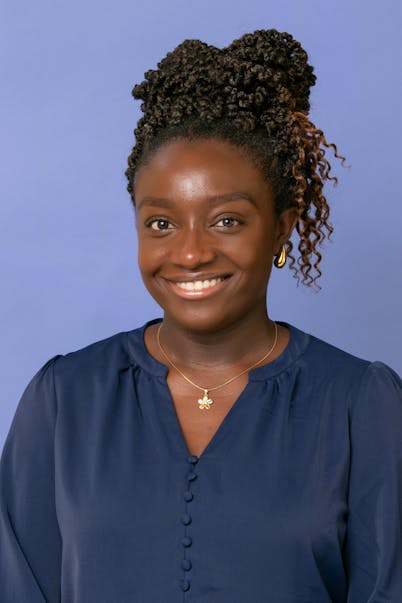
Amarachi Osuji is pictured.
Osuji works in the field of synthetic peptide synthesis. To understand what this means, let’s talk a little bit about proteins. Proteins are one of four major macromolecules of life — you can think of them as the workers of the cell. There are so many types of proteins: enzymes, motor proteins and signaling proteins, for example, and they are made of peptide chains which, in turn, are composed of amino acids. In cells, DNA is transcribed into RNA which is then translated into proteins by ribosomes. However, in the Kritzer lab, Osuji is able to actually build these peptide chains amino acid by amino acid, as if threading beads on a string.
In 2020, a paper published in the journal Nature showed a connection between a receptor called LRP1 and the spread of misfolded tau protein. Tau proteins typically function to maintain the structure of neurons, however, when these proteins misfold they cause neurons to clump together and die. Further, when misfolded tau comes into contact with normal tau, it causes the normal tau to misfold and become diseased as well. In this way, a few misfolded tau can cause a cascade of misfolding, resulting in the spread of disease through the brain.
This neuron death is implicated in various forms of dementia, including Alzheimer’s disease. LRP1 is a signal receptor on the outside of cells that, upon binding tau, tells the cells to bring the tau into the cell.
The goal of Osuji’s research is to design and test peptides that will inhibit LRP1, stopping the misfolded tau from spreading to more cells. There are several stages to a project like this one, and the very first step is designing the peptides. Although LRP1 is “pretty extensively studied” due to “a plethora of other functions in the human body,” Osuji noted that it has not been widely examined in the context of Alzheimer’s or neurodegeneration. “So for this project,” Osuji said, “I just looked in the literature to see, ‘are there other peptide ligands that have been studied to interact with this receptor?’”
She began by identifying nine peptides known to interact with LRP1. While these hadn’t been tested for interrupting tau binding, they offered a strong starting point. After producing and purifying the peptides, Osuji designed a custom assay to test their ability to stop tau-LRP1 binding.
From this assay, she identified a few peptides that impacted binding. From there, Osuji began modifying those initial peptides to enhance their inhibitory effect. Essentially, she found peptides that were mediocre at doing the job and then used those peptides as scaffolds on which she could build and improve.
But drug development is a long process that goes beyond one team of researchers, so Osuji also has “a collaborator at a different institution who is currently [testing the] hit peptides in cells,” specifically in a neuronal cell line, Osuji explained.
Just like drug development, getting a Ph.D. is a long and winding process and the project that becomes a student’s final thesis is often not the first or even the second project that they have worked on in a given lab. Prior to her current project, Osuji was working on a project involving the development of peptides that targeted proteins involved in a cellular process called autophagy. However, “the way science works is most things don’t work,” Osuji said. Their hypothesis for the autophagy project ultimately failed, and that data never led to a publication.
“There are pros to it, because I know that I got trained a lot in those three years when I was, you know, grinding at this project that wasn’t really working. So when I ended up on a project that worked beautifully, it was good, like I had all the skill sets that I needed to make this project succeed,” Osuji said.
Further, the successes make the struggle all worth it. “It almost feels like taking a flashlight and shining it into a dark room and just finding something exciting or interesting,” Osuji said.
“The possibility that what I’m doing today could be the beginning of very, very basic research for something that … might end up being a therapeutic in the future,” Osuji said. “This might actually end up being something viable that will be helpful and useful to people who suffer from neurodegenerative diseases [is] super exciting” — and a huge reason why she chose to pursue this degree in the first place.
Osuji leaves current and future graduate students with a reminder: “Don’t be afraid to say you don’t know and to ask for help.” In the long winding process of research, it’s the learning and the people around you that make it all worthwhile. “People are very, very willing and open to help” — all you need to do is ask.



