

Welcome to the first installment of “Dissertation Diaries,” a new column where we will highlight different doctoral candidates from various science and engineering departments at Tufts! Our first student profile spotlights Kevin Smith, a doctoral candidate in the Department of Civil and Environmental Engineering.
Smith completed his undergraduate education in a combined program between Oberlin College and Columbia University where he earned both a Bachelor of Arts in Environmental Studies (Oberlin) and a Bachelor of Science in Earth and Environmental Engineering (Columbia).
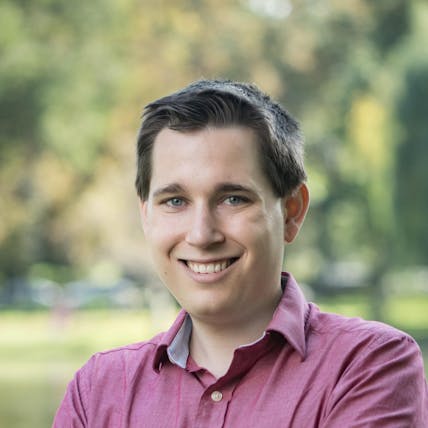
Kevin Smith is pictured.
“I came to Tufts right after that because I wanted to continue on this path of scholarship that blended both engineering and concerns outside of engineering and not being strictly focused on engineering problems,” Smith said.
Smith came to Tufts to participate in the Water Diplomacy Track, a traineeship funded by the National Science Foundation that facilitates interdisciplinary scholarship on water issues. In 2015, he started an internship with a company called Opti and he continues to work with this company in addition to his doctoral research. A central theme of Smith’s work at Opti and in his doctoral research is adaptation. His work at Opti takes on more of the infrastructure part of this theme.
According to Smith, Opti aims to address the question, “Can we better manage storm events by creating infrastructure that can adapt to the storm event itself?” One issue with passive stormwater systems is that they are like a giant bathtub — they have fixed dimensions. “Even though every storm event is different, you design for some middle of the road average storm that doesn’t exist,” Smith explained. One example he gave was for rainwater harvesting systems specifically. These systems aim to keep as much stormwater on site as possible to be used for other purposes (i.e. reusing for grey water or watering a green roof). However, you also want to minimize the amount of overflow that occurs because the extra water just ends up in the sewer or elsewhere where it causes problems. So, using forecast data, you can calculate how much water should be let go early in order to end up where you started.
Following on this theme of adaptation, Smith’s doctoral research looks at both infrastructure and institutions. Smith said the central question of his research is, “How do you think about policy that can accommodate changing future needs, and infrastructure that can kind of put those visions of changed policy into practice?” Both the issues he addresses and the solutions he considers transcend the typical boundaries of politics, culture and geography.
Smith’s thesis work focuses on a case study of the Great Bay National Estuarine Research Reserve, which protects the Great Bay, a body of water located between New Hampshire and Maine. He is specifically looking at how the issue of nitrogen pollution in the bay has been and continues to be addressed.
“[The Environmental Protection Agency] can regulate point sources of pollution, so pollution coming from things like wastewater treatment plants, but they cannot really regulate non-point sources pollution or pollution that comes from land use changes,” Smith said.
Further, cities and towns have jurisdiction over land use decisions. Thus, designing solutions to address these types of issues requires both new policy structures to regulate non-point sources and collaboration between several local jurisdictions. In the case of the Great Bay, several municipalities came together to address this issue. Smith is working to document this process and use it as a basis for future water diplomacy efforts.
It is important to note that these are not short-term efforts. The process of addressing nitrogen pollution in the Great Bay has been going on for multiple decades. For this reason, Smith explains that there have been both times when efforts stalled and times when it moved forward, and it is important to consider the context in which these things are happening. For example, a period of stagnation may have been a result of the federal administration at the time, but then you see the efforts continue a few years later as the political landscapes shift.
The transboundary nature and timescale of these projects is not the only barrier to progress. Another barrier is simply the vast amount of data and information that is involved in understanding, litigating and addressing these issues. For example, in the case of the Flint water crisis, huge amounts of data were posted online in response to Freedom of Information Act requests. However, these large data sets include multiple types of data and typically require expensive data science tools to analyze.
In a recent paper, Smith worked with Peter Nadel, the digital humanities natural language processing specialist at Tufts, to develop open-source data science tools that can be used to sift through such data. Many environmental management issues are led from the community level and thus creating these tools to make information more accessible is a key step in developing effective decision-making tools. While that paper focused specifically on the Flint water crisis, the tool created in that project will serve as a key piece of future water conservation efforts.
At the intersection of engineering and social science, Kevin Smith is working towards new decision-making frameworks that can manage and protect our water resources. Spanning disciplines, municipalities and timescales, the goal is to design infrastructure and policy that can adapt to a changing future.



