
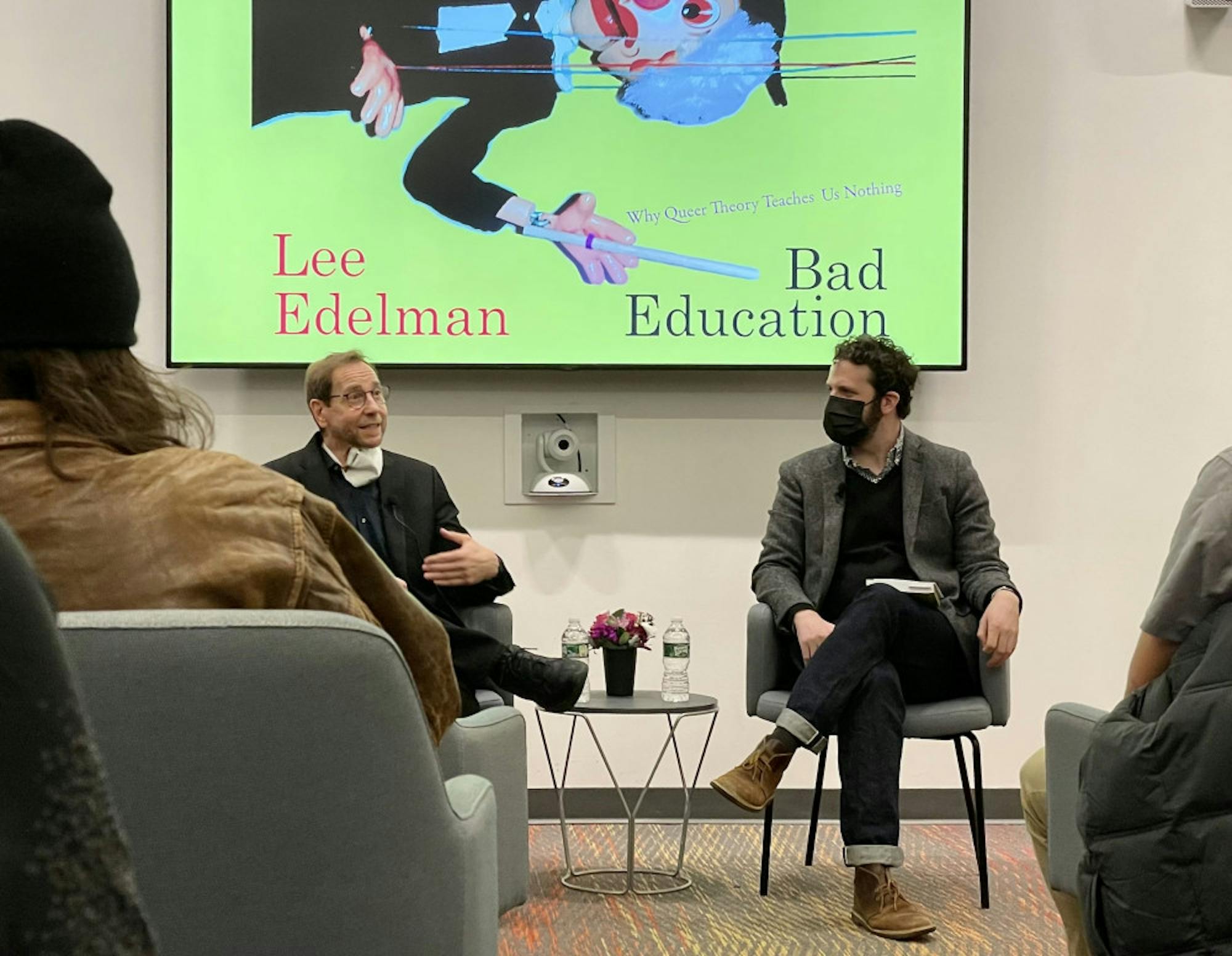
When Lee Edelman — a professor in the Department of English at Tufts and Fletcher professor of English literature — was a child, he wanted to become either a cartoonist or an architect. His career as a longtime professor at Tufts and a respected scholar of queer theory diverges from those early ambitions, but his path has been just as creative and carefully constructed nonetheless.
A lifelong academic, Edelman’s penchant for learning culminated in his fourth degree, a Ph.D. from Yale University in 1981. While finishing his dissertation at Yale, he was offered a teaching job at Tufts, where he has worked ever since.
Before entering the field of queer theory, Edelman studied 20th-century American poetry. He wrote his dissertation on the poet Hart Crane, later revising it and turning it into his first full-length book, “Transmemberment of Song: Hart Crane’s Anatomies of Rhetoric and Desire.” After winning The Nation’s Discovery Prize for Poetry in 1983, he gave a talk in New York on his work with 20th-century American poetry.
“It’s at that moment where I gave that reading that I realized that I did not want to be part of the poetry world,” Edelman said. “Some of my interests shifted from the creativity of writing poetry to the creativity of writing criticism. … As my focus switched more from using the theory to read the poetry to using the techniques of poetry to read theory, I became more and more persuaded that critical writing actually was, for me, a much more enjoyable and productive form of creative expression.”
In 1987, Edelman was invited back to Yale to speak at its first international lesbian and gay studies conference because of his prolific work on queer poets such as Hart Crane and Elizabeth Bishop. This moment marked the beginning of Edelman's engagement with queer theory. At the conference, he gave a presentation on a paper he had written called “Homographesis,” which would later expand into his second full-length book regarding the politics of sexuality.
“[‘Homographeis’ is] a collection of essays thinking about a vast array of different sorts of texts in relation to the emergent field of what was then called lesbian and gay studies,” Edelman said.
It also examined defining cultural moments, such as when President Lyndon B. Johnson’s aide was arrested in 1964 for homosexual activity in a public bathroom — an event that sparked broader conversation about the connection between communism and homosexuality.
“[The book] covered a range of texts from the 16th century through the 20th century, and it became the book that established my position in the field of queer theory,” Edelman said.
Edelman also discussed how the transition from what was formerly known as “lesbian and gay studies” to “queer theory” marked a pivotal shift in the field’s history.
“One of the reasons for the change in nomenclature was because, invariably, names seem to exclude. What I said was originally called lesbian and gay studies, actually was originally called gay studies, then it was changed to lesbian and gay studies. Then it became lesbian, gay and bisexual studies,” Edelman said.
The term “queer theory” was coined in 1990 by Teresa de Lauretis, a professor at the University of California, Santa Cruz. For Edelman, the field’s modern name — queer theory — expands the discourse around sexuality beyond fixed identities. His work does not focus solely on the experiences of lesbians and gay men or the historical situations of the different categories of sexual identity; instead, he situates queerness in broader contexts.
“Queerness is, as the very word suggests, a term that simply means whatever a given social formation conceptualizes as foreign or strange or unfamiliar to it — what gets cast out of the center and put to the margin,” Edelman said. “So in that sense, queer theory, at least as I am interested in it, is a theory of queerness. It’s a theory of how categories of queer exclusion operate in political registers.”
In 2004, Edelman published his third book, reaffirming his place in the study of queer theory. Titled “No Future: Queer Theory and the Death Drive,” the work established his new view of queer theory and its ethical perimeters. The novel engages with various literary and visual pieces, including Charles Dickens’ “A Christmas Carol” and Alfred Hitchcock’s “North by Northwest,” to argue that the child can be the answer for creating a world in which a queer person, by Edelman’s definition, is not vilified.
He has since published two more books: “Sex, or the Unbearable,” co-written with theorist Lauren Berlant in 2013, and “Bad Education: Why Queer Theory Teaches Us Nothing” in 2022.
While writing these works, Edelman continued to teach classes at Tufts on literary theory and film and media studies, many of which explore the intersections between literature and film.
“One of the things that is often true of academics is that they feel that they have to choose between research and teaching. … People feel, if they're going to do research, they have to make that their priority, and teaching will take a back seat,” Edelman said. “For me, teaching is just a thrill. It’s the opportunity to engage young, lively minds that are curious, open and responsive; and to get them to fall in love with film and literature as well; and to get them to see how film and literature are actually speaking to them.”
Edelman’s scholarship and teaching encourages students to become critical thinkers who can approach the world with open, informed minds. According to Edelman, while there may never be a society without exclusions, it is essential that there are always people willing to speak out against them — the very kinds of people Edelman hopes to inspire in his classrooms.
“You will never, in my view, achieve a society without exclusions,” Edelman said. “But one would hope you’ll never have to face a society where there isn’t resistance to those exclusions.”



