
On Wednesday, Jane Goodall passed away. She was 91.
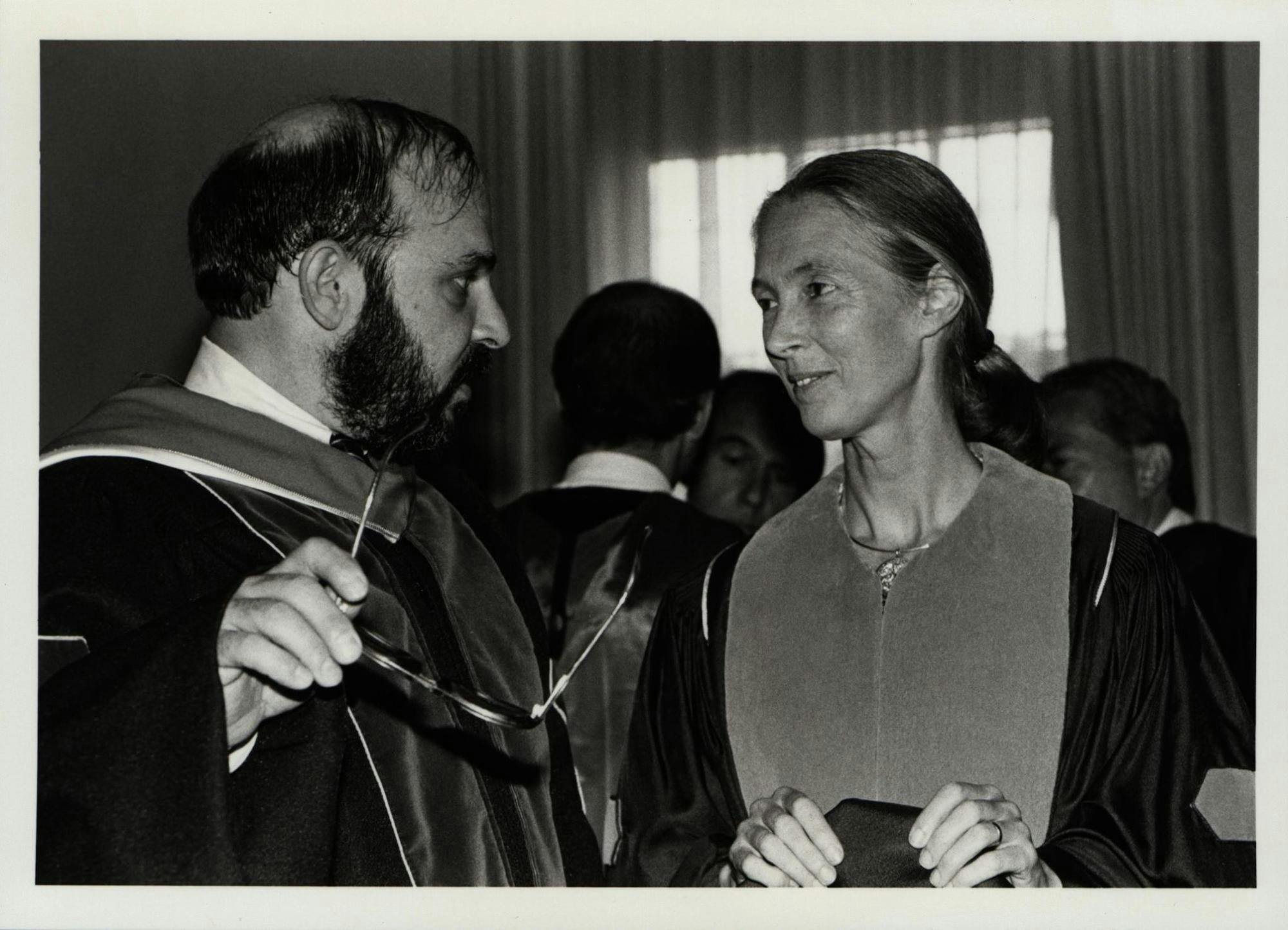
I was one when I first heard Jane Goodall speak. It was at my father and aunt’s Ph.D. graduation at Syracuse University in 2005. While I do not remember that speech, I think it may have unconsciously seeped into my little brain and shaped me into the person I am today.
Goodall was a giant in the world of conservation. She was 26 when she first traveled to Gombe Stream National Park in Tanzania to study the social behaviour of chimpanzees. Her seminal 1963 paper, “My Life with the Chimpanzees,” described her experience living with and learning about chimpanzees. She discovered that they can make and use tools, have incredible social intelligence and work and play similar to how humans do.
Goodall dedicated her life to the study of chimpanzee social behavior and her work showed the world that the line between human and animal was much blurrier than previously believed. “They kiss; they embrace; they hold hands. They pat one another on the back; they swagger; they shake their fist — the kind of things that we do, and they do them in the same kind of context,” Goodall said. Chimpanzees also engage in war among communities — a trait we once thought to be unique to humans.
Beyond her research, Goodall was a leading voice in the environmental protection movement. In 1977, she established the Jane Goodall Institute, a nonprofit aiming to protect chimpanzees and lead environment conservation projects. Today, the Jane Goodall Institute is a global organization of over 400 employees and thousands of volunteers.
In 1991, Goodall created Roots & Shoots, a Jane Goodall Institute program “to empower and encourage youth of all ages to pursue their passion, mobilize their peers, and become the compassionate citizens our world needs to ensure a better future for people, other animals, and our shared environment.” Goodall wanted to equip young people with the tools they needed to take action and she believed that every individual could make a difference.
Moreover, Goodall showed so many little girls and women that they belonged in science. “When I was a little girl, I used to dream as a man, because I wanted to do things that women didn’t do back then such as traveling to Africa, living with wild animals and writing books. I didn’t have any female explorers or scientists to look up to but I was inspired by Dr. Dolittle, Tarzan and Mowgli in The Jungle Book — all male characters,” Goodall wrote in Time Magazine in 2018. “Everybody laughed at me because girls weren’t scientists in those days,” she said in an interview with Margret Atwood in 2022.
When Goodall began her research in 1960, less than 1% of children drew a woman when asked to draw a scientist; by 2016, that number was up to 34%. Goodall was one of the many scientists that set the precedent for the women scientists of today. But feminism was never her primary focus — she just wanted to do her research and understand these animals that we knew so little about. No matter her intentions, she paved the way for aspiring women scientists like myself and inspired a generation of young girls.
Goodall’s work shed light on the lives and behaviours of chimpanzees and showed the world that humans and wildlife are not as different as they seem. “We’ve got to somehow understand that we’re not separated from [the environment]; we are all intertwined,” Goodall told CBS in 2024. “When we harm nature, we harm ourselves” — this was Goodall’s message.
Despite growing environmental threats, Goodall never stopped fighting or gave up hope. She believed that every individual could make a difference and that we should not be afraid to take on complex problems. Because of this, I believe she would have wanted me to leave you with this quote from her 2003 TED Talk: “So, yes, there is hope, and where is the hope? Is it out there with the politicians? It’s in our hands. It’s in your hands and my hands and those of our children. It’s really up to us. We’re the ones who can make a difference.”
I just hope that wherever she is now, she knows that there is a generation of young people that remain here and committed to the work she started.



