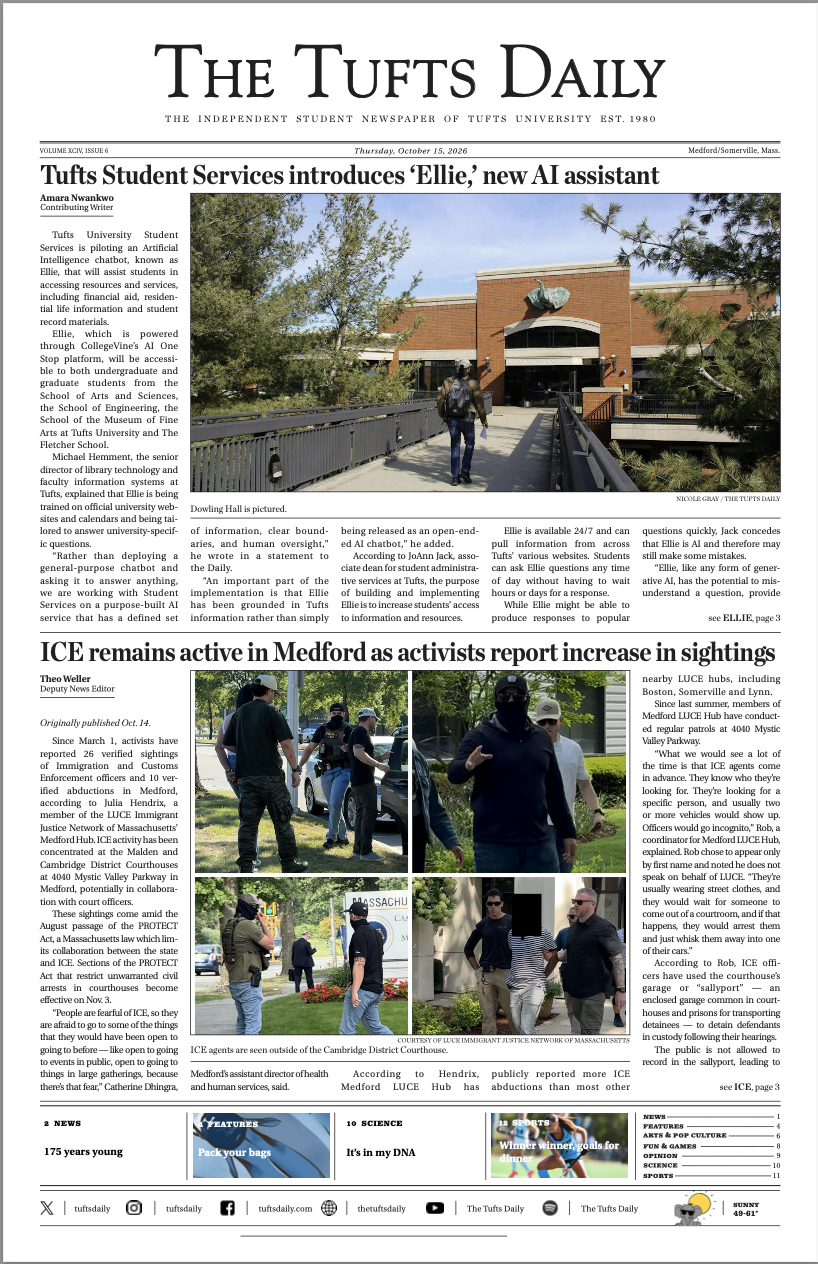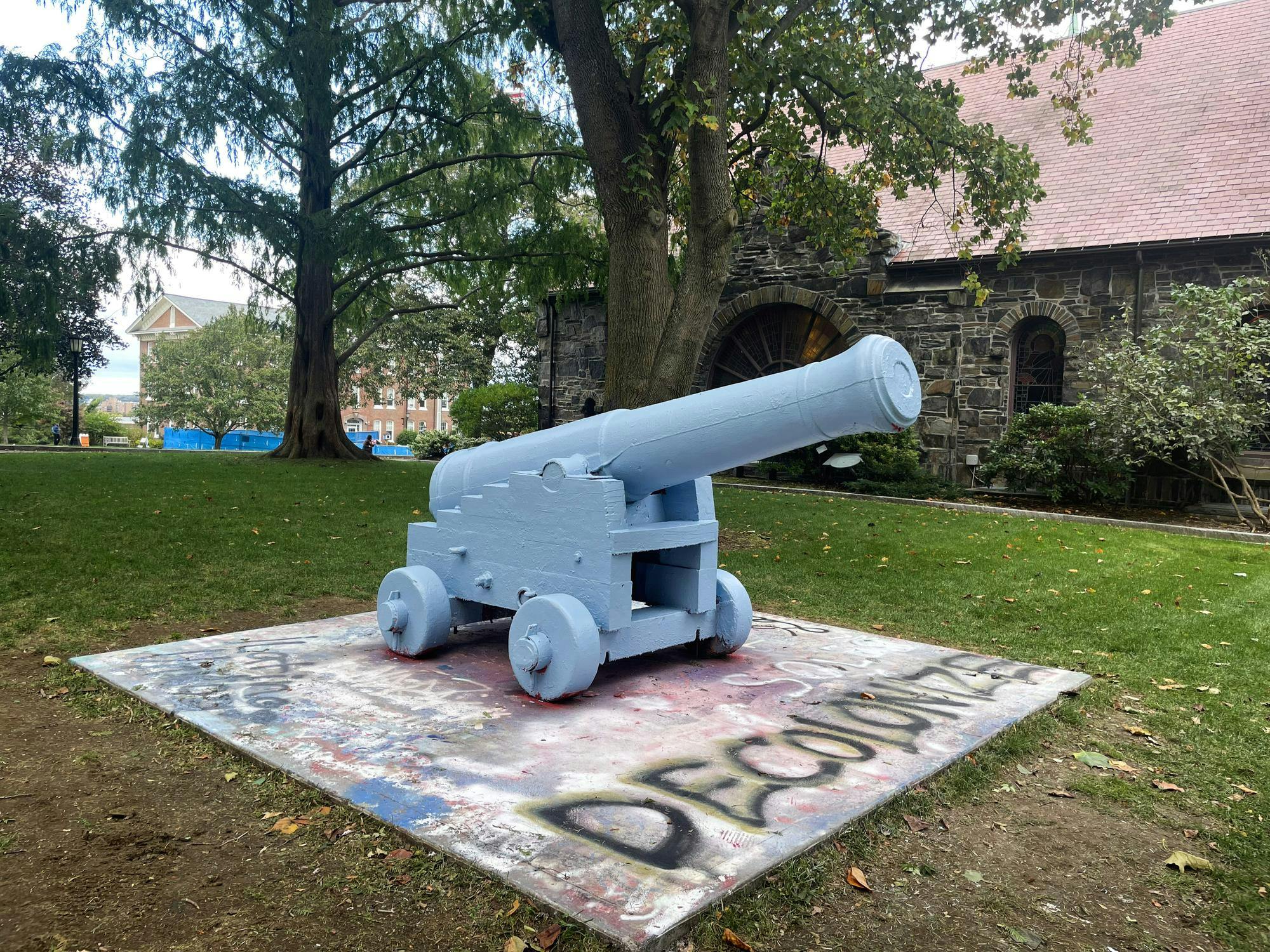
As a Tufts student, I am always paying attention to the cannon. A central part of student life, the cannon represents student voice, interests and activism. Whether you’re a member of the Tufts Cheese Club advertising the Cheese Ball or anonymous activists writing political messages, you can make your voice heard and seen by the broader community on the cannon. Every time I walk to Tisch Library or to a class near the Academic Quad, I stop by and see what students are up to. This is how I first noticed the cannon painted a blank sheet of blue by the Tufts administration.
This isn’t the first time the Tufts administration has painted over student speech. I wrote an article last semester when Tufts facilities were found painting over pro-Palestinian messages after a political back-and-forth between Tufts Republicans and anonymous students. I argued then that it was a completely inappropriate move by the Tufts administration. Not only was there little precedent for the repainting, but the political climate of the time — with Tufts graduate student Rümeysa Öztürk’s detention for expressing her voice in this very newspaper — made student speech even more vital to protect. Instead, Tufts opted to silence student speech in what I believe to be a move to limit potential backlash from the Trump administration. Now, seven months later, Tufts has fully regulated the cannon, systematically painting over it once a week.
I was so angry when I first saw that administration-approved blue that I began a two-week watch period. I went to the cannon every day to see when the cannon was painted over — it seemed to be every Wednesday night or Thursday morning. The official statement on the cannon justifies the repainting policy, claiming it seeks to “allow Tufts community members to share a wide array of thoughts, ideas and viewpoints without necessarily having to cover up someone else’s message.”
I have so many problems with this reasoning, mainly because it doesn’t accomplish its intentions. By painting over the cannon, the Tufts administration is hoping to avoid the qualms students might have with covering up other student speech. This is something that Gretta Goorno, former executive opinion editor and current managing editor, voiced last semester in an article published in tandem with my previous cannon article. However, instead of providing a solution to painting over our peers’ speech, Tufts is doing the job all on its own. The administration is forcefully inserting itself as a mediator of public discourse by actively covering up student voices. For the other six days of the week when the administration isn’t painting the cannon, students are still painting over each other’s work anyway.
I think that Tufts’ reasoning is nothing more than an excuse to intrude into student speech. What they didn’t have the precedent to do last year, they are building precedent for now. If Tufts finds itself in a similar situation as last semester, when something students write on the cannon goes directly against the Trump administration, in tandem with financial pressure on the university, Tufts can point to this policy when covering it up.
As I said last semester, I understand the logic of covering up controversial student speech. Much of the political quagmire Tufts has been embroiled in since Trump took office hasn’t gone away. The university is still facing federal funding losses and pressure to end diversity, equity and inclusion programs. At any moment, Trump and his cabinet could bear down on Tufts for seemingly any reason, making it almost impossible for the institution to function independently. But I said it in March, and I’ll say it again: These reasons do not make it right for the Tufts administration to dictate what students can or cannot say.
People can disagree with me, but the fact that the Tufts administration website omits the true history of the cannon says everything about its current actions. The cannon painting tradition started as student civil disobedience. In 1977, students who were against a $1.5 million donation from Imelda Marcos, the first lady of the Philippines at the time, painted the cannon in protest. Instead of acknowledging this history, the Tufts administration has chosen to sanitize it by only highlighting non-political ways the cannon is painted. Denying this political history doesn’t erase it. In fact, it only shows how consistent the university has been in stamping out student activism.
It’s also ironic that Tufts purports to promote a civically-minded student body while continuing a history of stifling student civic engagement. It’s hypocrisy if I’ve ever seen it. Tufts has an entire college dedicated to teaching civics to students, which is the only one of its kind in the country. As a civic studies major myself, I have witnessed the importance of civics lessons under our current political climate. Painting the cannon is part of that. Every time students paint the cannon, we see principles of civics — group participation and deliberation, for instance — put into practice. By butting into the cannon painting process once a week, Tufts both disrupts this expression of civic engagement and positions itself as a biased mediator of student speech.
Students should have the right to paint the cannon with messages that criticize our political leaders and our academic institutions. They also should have the right to advertise their clubs, promote fun events and celebrate holidays. One type of speech should not be prioritized over another, as Tufts is clearly doing in its own statement. I don’t know whether this is a new policy concerning the cannon, or whether it is an older policy that is finally being enforced. Either way, it is a terrible example of administrative overreach.
Tufts now has the precedent of covering up student political speech. Be that as it may, we students can’t let the administration think that repainting the cannon, even for seemingly valid reasons, is right. We need to protect what cannon painting originally stood for — what it still stands for: student speech, in all its forms.
Clarification: The policy of painting the cannon was instated by the university earlier this year. According to Dean of Students Camille Lizarríbar, "With the start of this academic year, the university adopted a practice of painting over the cannon every Thursday. We adopted this practice after numerous conversations last year in which students had indicated to us that they felt intimidated and feared being labeled, stigmatized or ostracized for painting over another group's message."