
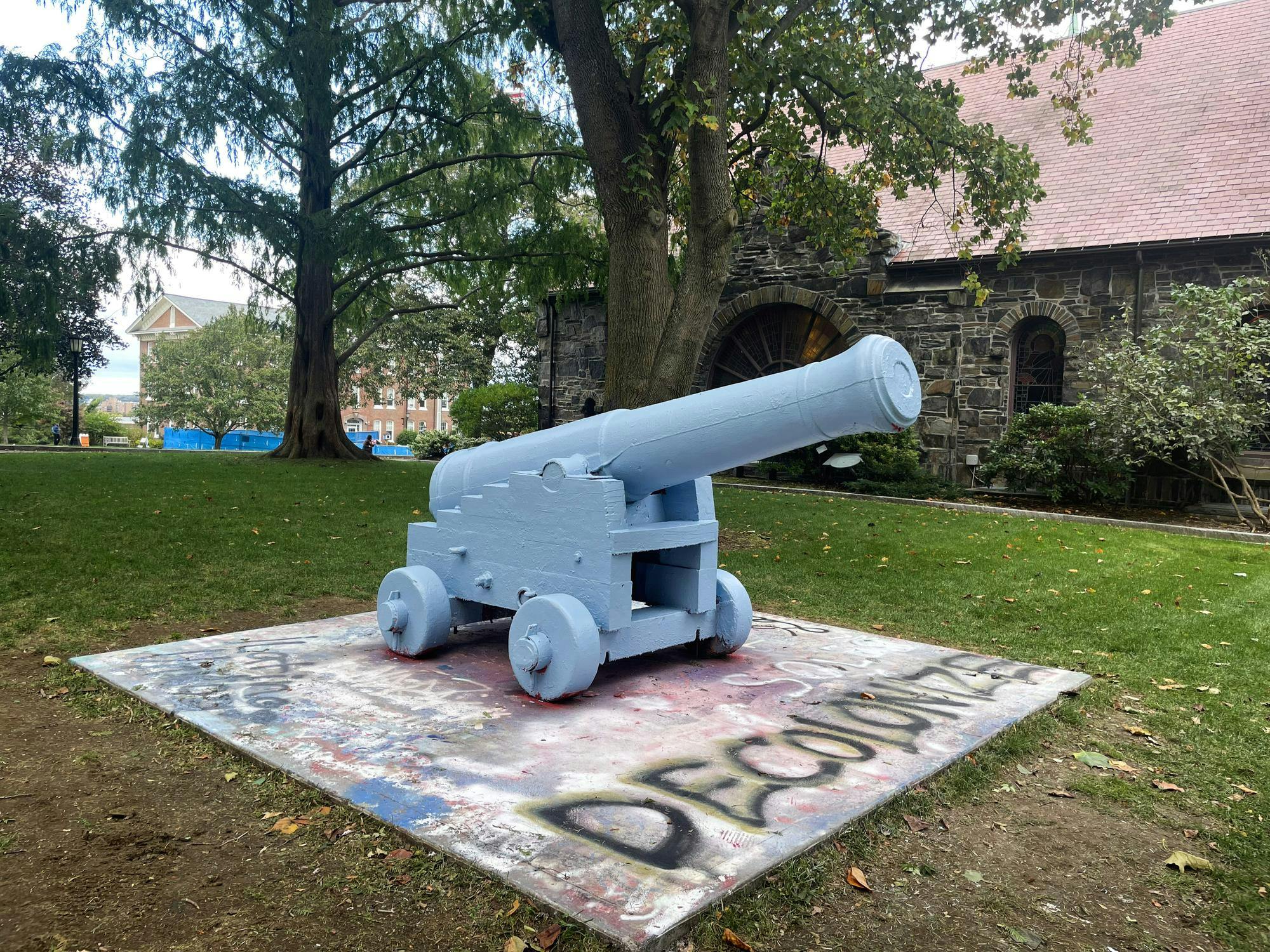
Tufts’ recent policy for painting the cannon — the site of a longtime Tufts tradition — has drawn student criticism since its implementation. As of this year, the university now paints the cannon gray every Thursday, along with periodic cleanings. According to Tufts, the shift was made to quell student fears about painting over other groups’ messages, while some students argue that the new regulations limit their free speech on campus.
A link to the “university’s policy regarding free speech and free expression,” which included the new guidelines about the cannon, was given to students in an email sent by Dean of Students Camille Lizarríbar at the beginning of the fall semester. She wrote in a statement to the Daily that the policy change was made in response to feedback from the Tufts community.
“We adopted this practice after numerous conversations last year in which students had indicated to us that they felt intimidated and feared being labeled, stigmatized or ostracized for painting over another group's message,” Lizarríbar wrote.
Lizarríbar maintained that the adjustment reflects the university’s values.
“By regularly repainting the cannon and offering a fresh canvas, so to speak, the university aims to ensure that students are free to express themselves and that their voices are not silenced,” she wrote. “This is in keeping with both the university’s commitment to pluralism and the tradition of the cannon as a platform available to all.”
Lizarríbar added that clearing the cannon after a certain amount of time is not a completely unprecedented practice and was “also part of the tradition.”
While the shift was implemented at the start of the academic year, several student groups were concerned after their messages were painted over without prior notice.
On Oct. 1, the Tufts Philippine Student Union painted the cannon to celebrate Filipino American History Month and foster club spirit, spraying it with the Filipino national colors and positive messages in Tagalog. The next day, the cannon was painted over in gray, without any notice to the club.
Junior Meg Santos, a co-president of the club, expressed concern when the cannon was painted over after just one night. “We immediately thought we had done something wrong. … It was hurtful.”
After an email correspondence with Richard DeCapua, senior associate dean of students and deputy chief student life officer, who referred her to Lizarríbar’s email on free speech, Santos challenged the university’s justification for the change.
“It just seems unnecessary as a whole to me. … I haven’t even heard any students, in painting the cannon, say that they feel uncomfortable painting over students’ work. Where did this all come from?” Santos said.
The Philippine Student Union and other Filipino student groups on campus have a long history with the cannon and played a role in the birth of the tradition. In 1977, the cannon was reportedly painted for the first time when a group of students protested the university’s granting of an honorary degree to the wife of Ferdinand Marcos, the then-dictator of the Philippines. The cannon was repainted several times in response, and eventually cemented itself as a Tufts ritual. The club had hosted a presentation about the history immediately prior to painting the cannon on Oct. 1.
Sophomore Eva Tutin questioned whether the new policy would truly enable students to feel more comfortable painting the cannon.
“Does that mean Tufts University is hoping that the cannon will only be painted once a week? Because the other six nights of the week, people are still painting over each other,” she said.
According to Tutin, the administration’s involvement in painting the cannon could interfere with the way that Tufts students usually interact with the cannon, resulting in less participation in the tradition.
“If Tufts University continues to paint over the cannon frequently, it will slowly change campus culture. I wouldn’t stand out there in the cold painting a cannon if I believed that it would be gone the next morning,” she said. “This is the most normalized platform for voicing dissent on campus, and if that goes away, there is nothing to replace it.”
Santos emphasized the importance of raising student awareness on the origins of cannon painting and its roots in freedom of expression.
“The beauty of the cannon is its lack of rules,” she said. “People like it because the institution is not involved in any way.”



