
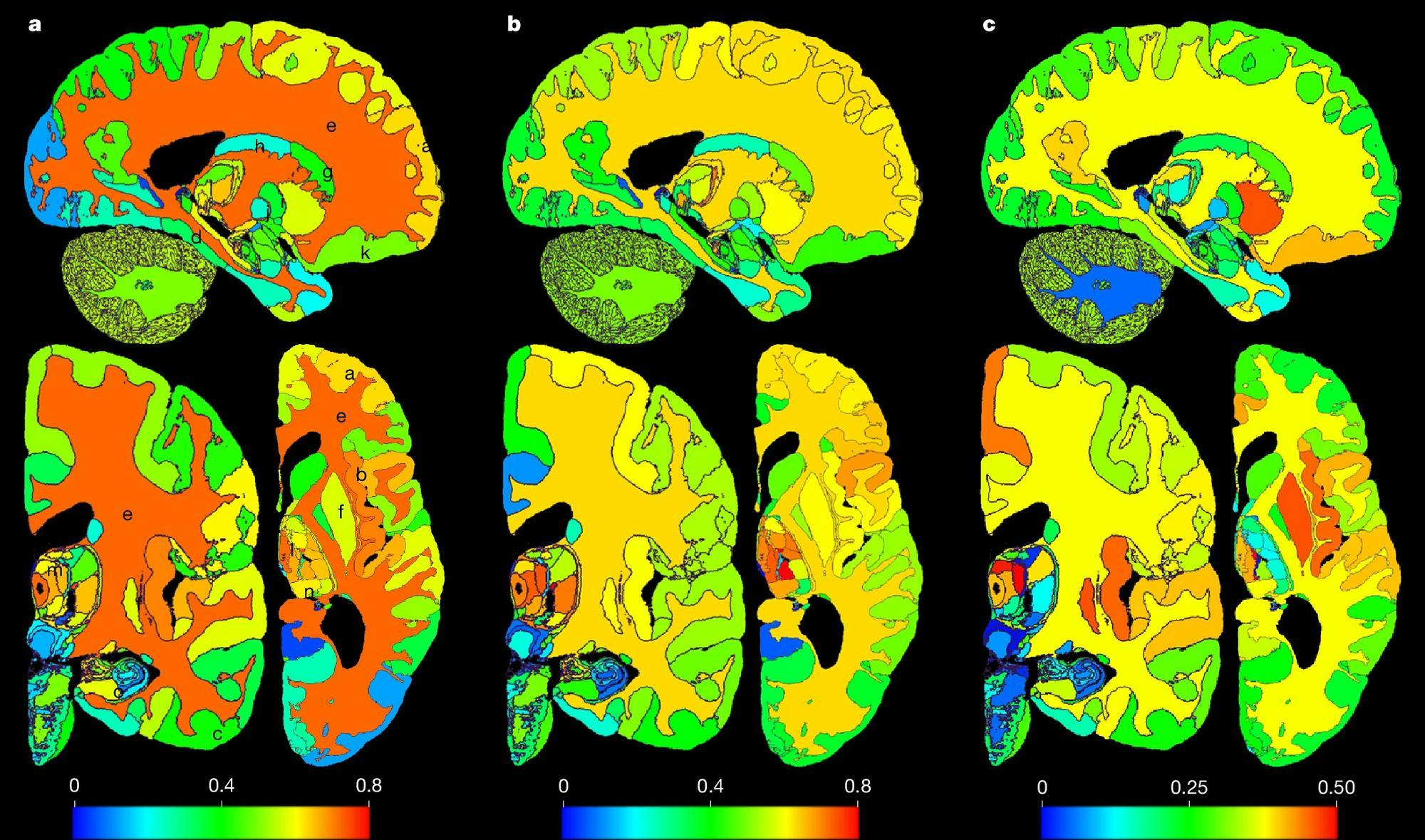
Recently, a neuroimaging study funded by the European Research Council introduced “NextBrain,” a three-dimensional, probabilistic, high-resolution brain atlas that maps the brain into 333 regions to assist with MRI analysis, powered by artificial intelligence. In neuroimaging, a brain atlas functions like a standardized coordinate system for the brain structure: It allows researchers and medical professionals to label and analyze the same anatomical regions across different brains so that results can be compared “in a common coordinate frame.”
Brain atlases can be used to analyze MRI scans of patients: While MRIs cannot capture high-resolution cellular information, brain atlases provide cellular data for comparison. Previous atlases relied primarily on either histology or MRI scans; NextBrain combined both to create a higher-resolution model. Histology involves dividing ex vivo (unalive) human brains into small pieces and staining them to reveal their cellular architecture. This process allows researchers to analyze tens of thousands of pieces in detail. On the other hand, MRI scans can be performed on living patients but lack the resolution to detect certain subregions crucial for early disease diagnosis or research. By connecting both approaches using Bayesian segmentation and machine-learning algorithms, researchers attained significantly higher accuracy. Earlier brain atlases typically mapped one or several brain regions without detailed labels. NextBrain changed this by identifying and labeling 333 “regions of interest” in the brain.
I interviewed one of the researchers behind NextBrain, Dr. Eugenio Iglesias, about the research process going into this project and their expectations for the future. Iglesias currently works in brain imaging.
When building NextBrain, the team focused on mapping the “volumes of the different regions” of the brain, using five sample healthy adult brains. Development took approximately six years.
“We stained one section every day on average,” Iglesias explained of their delicate process. “So, the actual sections that we got were probably closer to 100,000. We just didn’t stain all of [the sections], which would have been an absurd amount of work that doesn’t really give you a lot of new information.”
The researchers initially planned to map one brain region before expanding to the entire brain. However, scaling up proved complex due to “geometric decision” challenges in determining the right way to cut the brain into meaningful sections.
“At one point, you’re really forced to make some decision of whether you’re going to cut a very small block. It’s going to be either too large or too small,” Iglesias said.
The brain also had to be cut to fit the standard 74-by-52-millimeter slides for the microscope.
“The first brain was, of course, the hardest. It took a long time to figure out the protocols.” Iglesias mentioned of the process. Completing the histology and scans for the first brain took two years, while the remaining brains took approximately nine months each.
There were also surprises during this process. Although all five donors had been classified as healthy and their brains were scanned with an MRI before histology, a tumor was discovered in one brain during sectioning.
“In terms of findings we didn’t expect, … this person was healthy, they gave their brain to science. We already scanned [their brain],” Iglesias explained.
He further emphasized that finding healthy deceased donors is difficult, which became a limit for their experiment.
“When you work with atlases and models derived from MRI scans, it is much easier. Because you can scan people of all ages. … But if you want to build a model using histology, you need a donor, and your sample size is going to be very limited,” Iglesias explained.
To address this challenge, Iglesias described the new additions his team has made to their atlas since submitting their paper two years ago: “When we apply the atlas to a new case, we don’t do it directly. … We do a primary course segmentation using a deep neural network that is trained with thousands … of scans. And we use the output of that neural network, which doesn’t have as much detail, but is super robust and has information from a wider range of ages … to assist the mapping of the atlas onto the new subject.”
This method aligns with the team’s initial idea of the brain atlas. As the researchers initially claim to base their model on volumes, instead of the functionalities of the brain regions their machine learning process to approximate their model to a wider range of patients does not create a barrier that would significantly create incorrect results.
“I don’t think it’s on the paper itself, but it’s on the correspondence with the reviewers, which is available online. … [It] shows that essentially, the performance of the atlas doesn’t change much with age,” Iglesias added.
He also said that the first author of the paper “wants to actually figure out a clever way of mixing these five cases from really old people with tons of MRIs of younger people, and try to build an age dependent NextBrain.”
Following completion, researchers conducted “sanity check” experiments on Alzheimer's disease and aging patients. They applied the atlas to MRI scans from 168 Alzheimer’s patients and 215 healthy controls. The model achieved 90.3% accuracy, compared to 86.9% with the Allen MNI atlas, described as “the only competing histological (or rather, histology-inspired) atlas that can segment the whole brain in vivo.”
Currently, the NextBrain Atlas is open to public use. Iglesias emphasized that he is “very happy with what [they] have now and [he’s] really hoping that people will use [NextBrain].”
The team made the platform accessible through instruction videos and clear documentation, allowing users to integrate the atlas into research and medical analysis worldwide. As one of the highest-performing atlases for region-of-interest segmentation, NextBrain may help researchers combine functional data with detailed anatomy to improve brain-decoding research. Iglesias emphasized that while the team welcomes collaboration, the software is also designed for independent use.



