
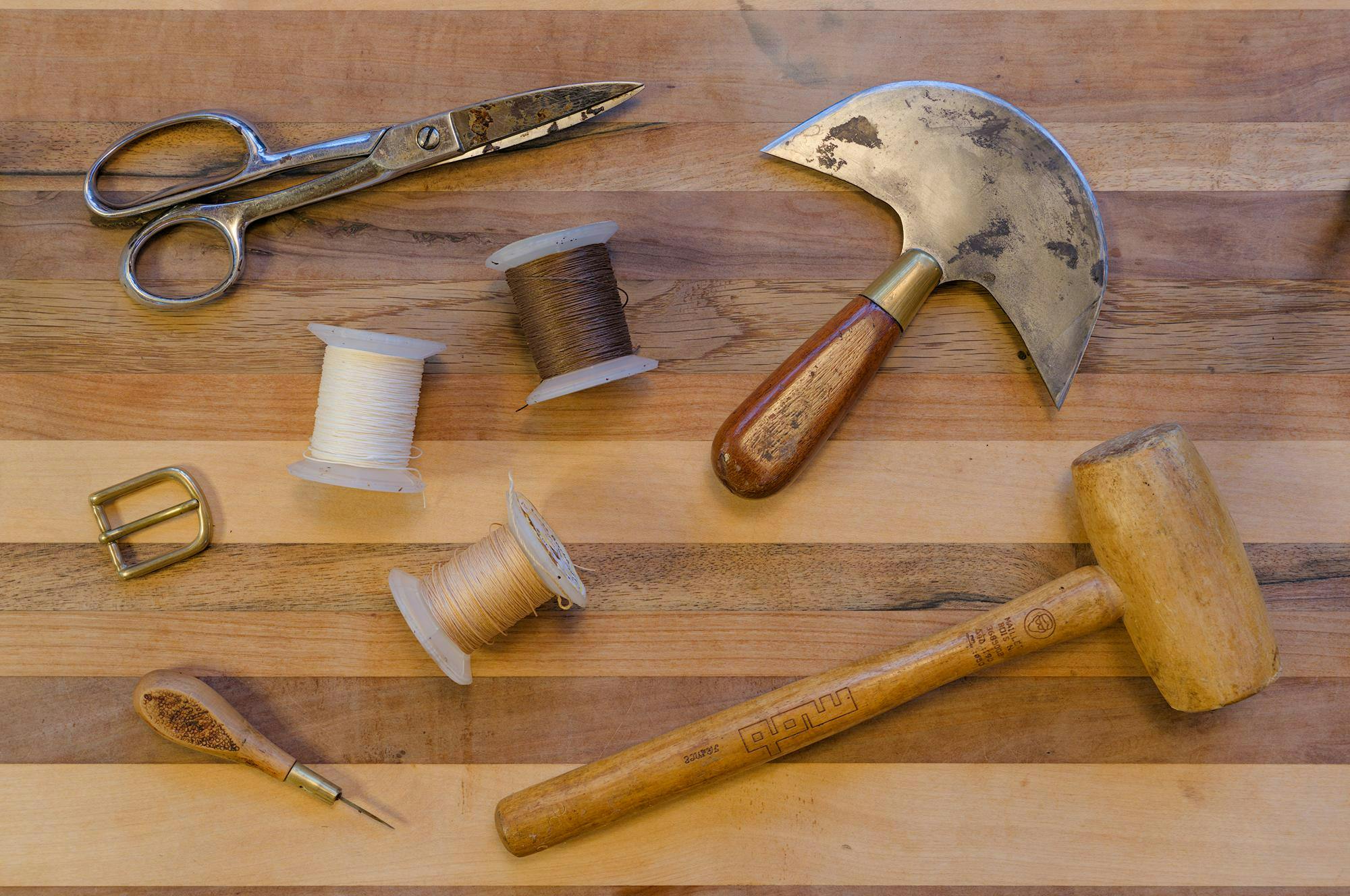
Leatherwork is a relatively new love for Basil Cleveland, president and cofounder of the Boston Leather Guild. He discovered the material around five years ago through a different hobby –– woodworking.
He became enamored with leather while making a wooden tray with a leather interior. According to Cleveland, he enjoys working with leather for the same reasons that people love a favorite bag. “It feels luxurious on the one hand, it feels good against your skin. It looks beautiful the way the light hits it,” Cleveland said. “It hadn’t occurred to me that you could look at leather as a material with really interesting properties that way, whereas wood, it’s really obvious.”
Beyond the material itself, Cleveland values the process of leatherwork. “To make something with your hands and then to have it exist in the world, that’s a real joy,” Cleveland said. As someone who codes extensively in his professional life, Cleveland has observed the rise of artificial intelligence. He said that when you use AI, “you can almost feel yourself sort of pouring out, whereas with woodcraft and leathercraft … the agency is just you. There’s no dilution of it.”
Cleveland goes through four iterations of each design. “My goal in making any one of these projects is to work toward a kind of superhuman model, just something incredibly beautiful, where if you pick it up, you just can’t believe a person made it,” Cleveland said. This endeavor requires a massive time commitment, which doesn’t bother Cleveland.
He described the experience of a crafter: “You’re approaching an art form, and you know you’re going to fall short of it, but it’s incredibly satisfying to press up against the edge and see what you’re capable of, and you improve every single time you do it.”
The commitment shown by Cleveland and other leathercrafters differentiates their pieces from mass-produced items. Cleveland articulated the contrast through the example of a wallet. “When you buy a store-made wallet … it looks like something you’ve just come across, and there’s nothing exceptional about it.” On the other hand, a crafted wallet “takes on this aura … [of] there’s no way to make this except by hand and by someone who clearly cares about every component of it.”
Wallets are particularly useful examples because, while simple, their fabrication demands precise techniques that are often lost on the average person. Cleveland acknowledged that “there’s a little bit of connoisseurship here that’s required to appreciate a fine leather good,” which he didn’t possess until working with leather himself.
Jennie Siegel, Cleveland’s friend, shares his passion for leatherwork. Around two years ago, the two began a “leather club” in which they got together weekly at Cleveland’s house to work side by side on various projects. “And it was fun … then I thought, well, there must be a guild around here,” Cleveland said. “And there wasn’t. Not only not in Boston, there wasn’t anything in New England.”
So Cleveland bought a website URL. He and Siegel began publicizing their guild with flyers, then expanded to social media and finally partnered with the Somerville library for a meeting space. “We’re at about 81 members now,” Cleveland said. “I’m pretty sure that makes us the largest leather guild in America.” He credits the expansion of the guild to its consistent social media presence. Their location plays a role as well. Although people often associate leatherwork with rural activity, Cleveland said “the vast majority of leathercrafters in the U.S. are in big cities, because that’s where the population is.”
Every other month, the guild organizes a contest. This April, guild members will create and showcase sheaths. “We already have a bunch of people who are clearly cheating in this project, which is part of the fun, because what’s a sheath?” Cleveland said. He added that his own entry “breaks all the rules,” which he also “declared for this contest.”
Guild membership includes everyone from hobbyists with day jobs like Cleveland himself, to bootmakers, leather historians and professional bagmakers. “The guild members are just the absolute best people,” Cleveland said. “If any Tufts students are ever interested in leathercrafting and they just want to get started, come and join a meeting. We love welcoming beginners,” he added.
Creating the guild demonstrated to Cleveland the demand for community. “If I would have known how easy it was, I probably would have started on it sooner. It turns out that people are really grateful if you’ll organize something,” Cleveland said. Cleveland and Siegel are now trying to make the guild more self-organized. “We’re trying to make it so that it’s easier for everyone in the guild to collectively push in whatever direction they want to go,” Cleveland said.
Although virtual crafting networks exist, Cleveland values offline communities. “Starting the Boston leather guild makes me realize that actually what I care about is people who want to come together and have a personal, in-person, real-life experience with me.” He hopes the guild will be a “model, both for [himself] and others, in terms of going out and just making a collective space where people can come together to have fun, and no permission is required.”



