
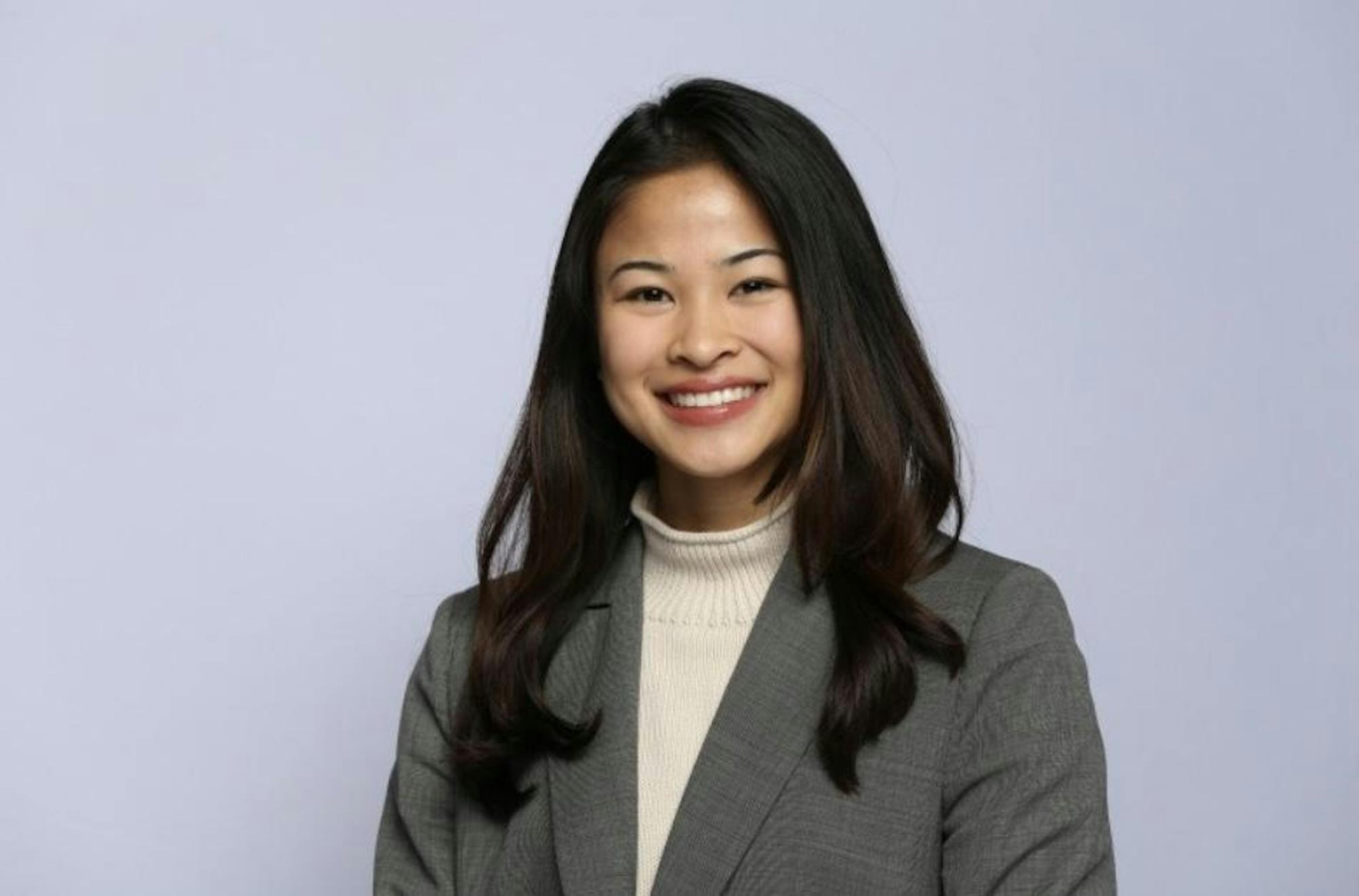
This installment of Dissertation Diaries highlights Gabriella Floro, a fifth-year Ph.D. candidate in the Tufts University Department of Chemistry. Before coming to Tufts, Floro completed a Bachelor of Science in Chemistry at Centre College.
As one of the first graduate students to work with Dr. Kevin Clark, a bioanalytical chemistry professor and researcher, Floro has pursued multiple projects throughout her degree, with an overarching theme of separating and better detecting RNA modifications at the nucleoside level.
RNA modifications are reversible chemical modifications on RNA, and they play important roles in many biological processes. For instance, a certain RNA modification may promote mRNA stability, thereby enhancing protein translation. Understanding the role RNA modifications play in protein translation may provide insights into disease progression and inform treatment.
RNA modifications aren’t just something created in a lab; they exist within us, and scientists can leverage them to advance medicine. For example, Floro discussed how specific RNA modifications were imperative in increasing the efficacy of the COVID vaccine, saving millions of lives during the pandemic.
Floro’s main research aim has been to enrich RNA modifications for detection via various methods. She mainly employs liquid chromatography mass spectrometry, which is a technique that is used to separate compounds from a sample before further analysis.
One new technique she’s been exploring is trapped ion mobility spectrometry (TIMS), which separates gas-phase ions depending on their size and charge. Once performed, she can use the data to analyze RNA modification profiles within a sample, giving insight into what’s occurring in the epitranscriptome.
While still in the exploratory phase, Floro and other members of the Clark group have been trying to implement TIMS as an alternative detection method for RNA modifications, believing it to be a better, more sensitive method of detection.
All things considered, one of the main questions researchers in the Clark Lab are tackling is analyzing which biochemical changes occur during learning. Research by Eric Kandel, the 2000 Nobel Prize in Medicine awardee, has already shown that chemical changes occur within the brains of sea slugs in response to physical conditioning. The Clark Lab has built upon this, investigating the RNA modifications that occur during learning that have yet to be characterized.
“Other research groups are doing amazing work uncovering what changes are happening to the DNA or to the protein, and here we’re at the intersection between the two by looking at RNA,” Floro remarked.
Coming out of undergrad, Floro had a broad chemistry background, having conducted research at Tulane University on polymers. “I think that’s [what] made me interested in an interdisciplinary type of research program, like the one I’m in now, where we do neuroscience and biochemistry and analytical chemistry,” Floro reflected.
Her decision to attend Tufts was two-fold. First, Floro knew Boston had a reputation as a biotech hub, hosting opportunities that might not have been available in her home state. Secondly, the mentorship of her peers and professors at Centre inspired her to pursue a Ph.D., saying that they had “laid out [a] roadmap” for her research journey in her uncertainty.
Within the department, Floro has been part of the Chemistry Graduate Student Council, which is involved with planning both social and departmental events. Additionally, the council helps host open houses for potential admitted students.
The guidance Floro received as an undergrad influenced her own mentorship philosophy. Working as a recitation teacher’s assistant for Organic Chemistry I and Bioanalytical Chemistry, she stated that she’s “been excited to work with students in that form of mentorship that [she] received at [her] university.”
Outside of the university, Floro enjoys crafting, in particular bead embroidery, knitting, crochet and designing posters.
Ph.D. journeys are non-linear, and every candidate experiences a different set of challenges and growth along the way. “You’re learning how to be an adult, but you’re also learning how to be a scientific researcher,” Floro commented on the duality of pursuing a Ph.D. in your 20s.
Looking beyond Tufts, from working with instruments in industry to becoming a professor at a university, Floro’s open to all career possibilities post-grad.
When asked if she had any advice for undergrads considering a Ph.D., Floro strongly recommended considering a gap year. She did not take a gap year herself, but she believes that it would be beneficial in helping one understand exactly what they value in a program, to help inform their decision on whether or not to dedicate five years of their lives.
“There is so much time before that decision can be made,” Floro reflected.



