
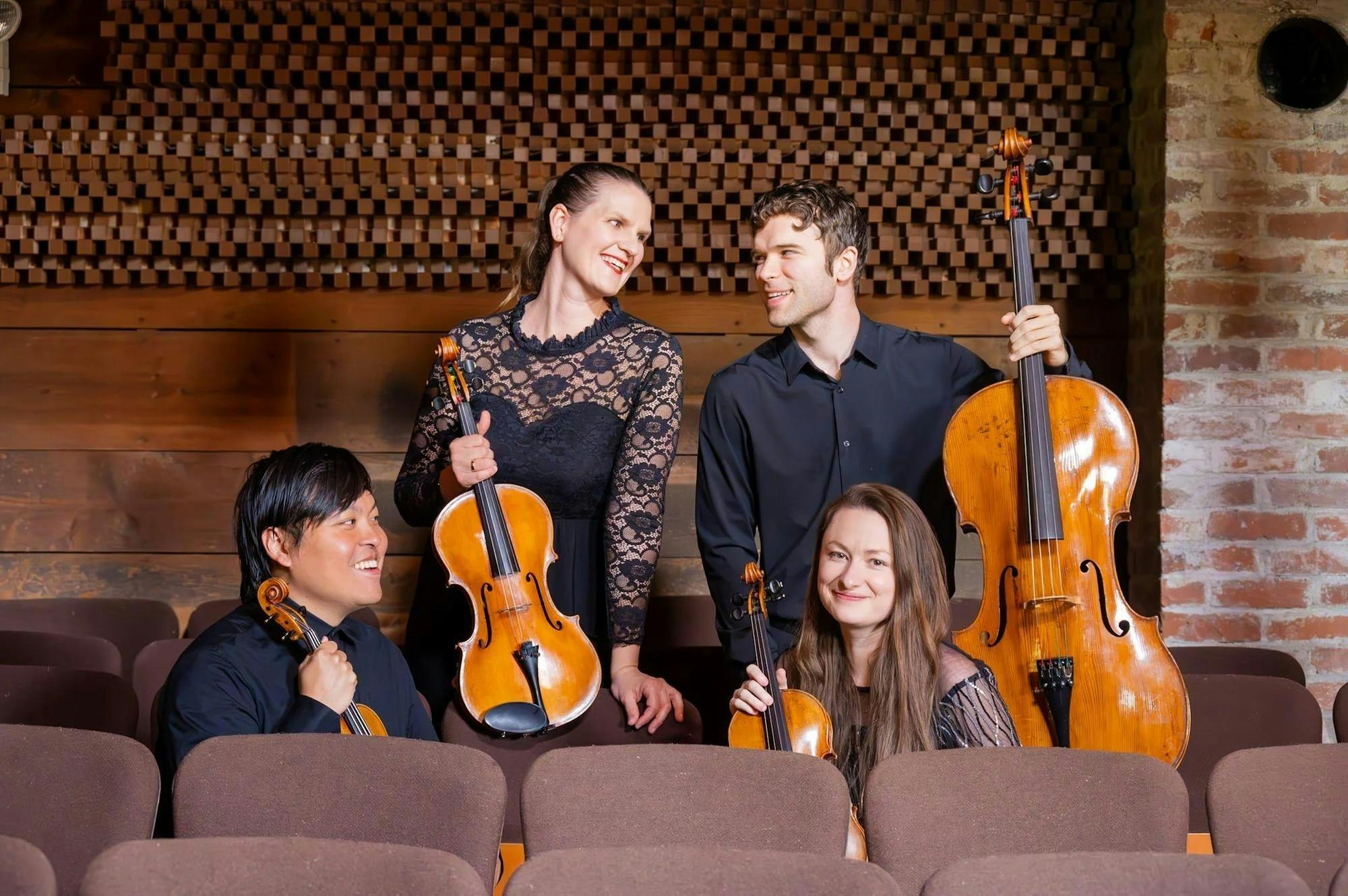
On Oct. 2, the Goethe String Quartet performed at Distler Performance Hall in the Granoff Music Center, playing Michael Gilbertson’s “Striking Distance,” William David Cooper’s “Skizzen” and Ludwig van Beethoven’s “String Quartet No. 8 in E minor, Op. 59, No. 2.”
The Goethe String Quartet takes its name from Johann Wolfgang von Goethe, who described quartets as “a conversation between four intelligent people.” The four performers include violinists Luke Hsu and Laura Rickard, violist Marthe Husum and cellist Rainer Crosett. Each is an accomplished soloist with international recognition. As a quartet, they have performed across the United Kingdom, the United States and Europe, playing repertoire from the standard canon to contemporary works.
Within the Greater Boston area, the quartet has performed in Wayland, Mass. and Wellesley, Mass. as part of its 2025 American Tour. At Wayland, they premiered Cooper’s “Notturno,” Eun Young Lee’s “Non Più Mesta” and Reinaldo Moya’s “Farbkreis” alongside Beethoven’s “String Quartet No. 15 Op. 132.” On Oct. 2 at Tufts, they played works by Gilbertson, an associate professor of composition at Berklee, and Cooper, a lecturer in the Department of Music at Tufts University.
Gilbertson writes music that critics have called “elegant,” “vivid, tightly woven,” “delectably subtle” and a “compelling fusion of new and ancient.” His compositions made him one of three finalists for the 2018 Pulitzer Prize in Music; and ensembles including the Minnesota Orchestra, San Francisco Symphony and the choir, The Crossing, have performed his work.
Gilbertson’s “Striking Distance” plays with drama and contrast, and, as a whole, sounds akin to a film score, though not one for a single film. I found myself picturing pieces of it as separate scenes. The piece seems to value unpredictability above all else. The dissonance is jarring, but in a way that evokes mystery and the unknown. No two sections neatly resemble each other, and yet the whole piece holds together nicely. The resulting effect is a dynamic, yet memorable piece.
Cooper is best known for his vocal and choral music, including his opera “Hagar and Ishmael”; its “richly soaring vocal lines” have been praised by critics. His commissioned works include “St. Luke Passion” and “Requiem” for St. Peter’s Church in New York City, and his work has been presented by Fort Worth Opera and West Edge Opera. He collaborated with the Goethe String Quartet for his 2025 premiere of “Notturno.”
Cooper’s newly released “Skizzen” takes its inspiration from the intervallic progressions of John McDonald, a Tufts emeritus professor of music, who was in the audience Friday night. While introducing his piece, Cooper described the ending as “sort of the anti-climax of the piece. It builds and builds, and it suddenly arcs high.” Another source of inspiration was his brother. “This [piece] is a kind of reflection on my brother who went through a difficult experience this summer,” Cooper said.
Listening to the quartet play “Skizzen,” I felt an almost unending tension. The plucked strings, interval progressions and harmonics lend the piece an eerie quality. At the time, it was difficult to know whether the tension would break or continue. It did not end. The concluding section, as Cooper foreshadowed in his introduction, is anticlimactic. The audience is left with a harmonic grace note in the air. Perhaps the arrangement speaks to the larger theme of conflict when there is no resolution.
The final piece contrasts with the earlier contemporary pieces before it. The quartet played all four movements of Beethoven’s “String Quartet No. 8 in E minor, Op. 59, No. 2”: Allegro, Molto Adagio, Allegretto and Finale. The first movement opens with nervous energy, beginning softly and swelling louder to heighten the anxiety and keep listeners hooked. The second movement washes that unease away. The Quartet gave it a lush and calm performance, and yet the movement of the players on stage remained dynamic. The third movement is lighter and livelier, though its E minor key hints at the underlying uneasiness from the previous two movements. To end the night, Finale was bouncy, playful and extroverted. Its notes were short and detached, and there was constant movement throughout the piece, among the players and the audience, ending the night with a standing ovation.
The Goethe String Quartet’s concert was part of the Granoff Music Center’s 20th anniversary season, which continues this fall with a colloquium series and concerts. Upcoming events include “A Journey Home with the Khmer Urban Ballet” on Oct. 21 and “The ‘Making Of’ the Perry and Marty Granoff Music Center” on Oct. 26.



