
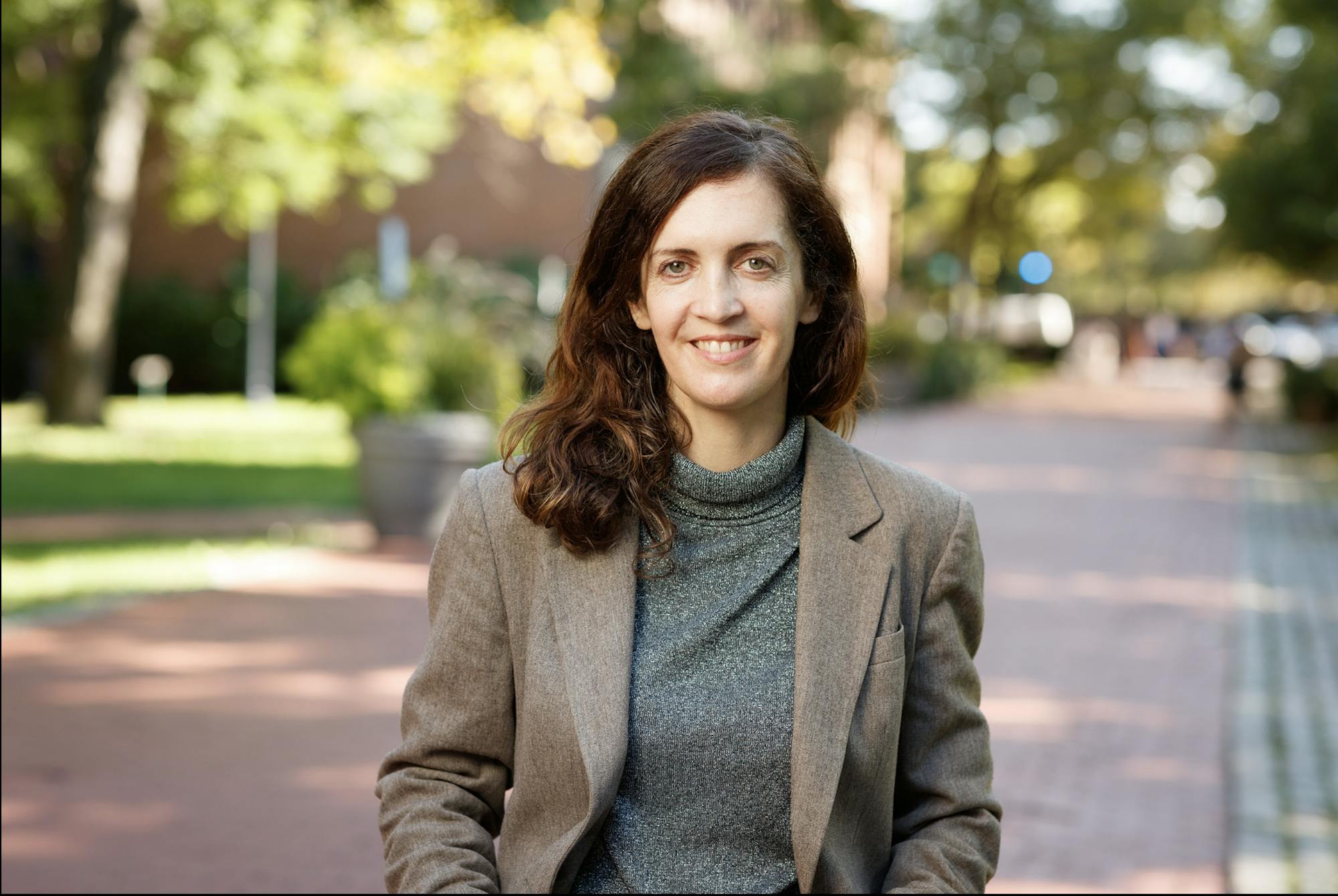
Mary Mattingly’s visual art tackles more than some would ever think is possible.
Mattingly, a New York-based interdisciplinary artist, has begun working with The Center for Humanities at Tufts in the University Ecologies and the Question of the Commons project to imagine the future of the campus as a commons.
“For a long time I’ve been trying to work at the intersection of art and ecology, with a focus on climate, and sometimes that means living structures,” Mattingly said. “I like to say that I intentionally co-create ecological living systems that people can partake in in some way. They’re usually interdependent, so you need some inputs to allow them to work and see them function.”
One of Mattingly’s works, “Swale,” is a barge-based floating food forest in New York City which was open to the public for foraging. The project was initiated in 2016 in opposition to a long-standing NYC Parks Department rule against foraging and helped catalyze the city’s first public “foodway” for legal foraging in the Bronx. Right before the COVID-19 pandemic, Silvia Bottinelli, a teaching professor at the School of the Museum of Fine Arts at Tufts University, reached out to interview Mattingly about “Swale” while working on a book about artists’ work with food. Bottinelli recognized the work as a good case study for SMFA students, and Mattingly accepted an invitation from Bottinelli to come and talk with the students.
A couple of years later, Bottinelli, along with Alex Blanchette, associate professor of anthropology, pursued a Mellon Foundation grant for the three-year University Ecologies and the Question of the Commons project, which is hosted by the Center for the Humanities at Tufts. The project explores re-commoning the ecological monocultures that have been developed by American universities. At the beginning of the project, Bottinelli and Blanchette invited Mattingly to be on a panel around food and farming, which took place on April 10. When there was an opening for a longer-term position as a visiting artist, Mattingly jumped at the opportunity.
“I was thrilled at the chance to apply because it had all of the things that I hope for when doing a project, which is lots of involvement,” she said. “So it starts as one idea, but then it gets to iterate and change the more people contribute to it.”
“The question I’m starting my time off with here is: If universities helped build and circulate the agricultural systems that we have now, what role might they play in cultivating the systems that we now need?” Mattingly said, speaking at the Hoch Cunningham Environmental Lecture on Sept. 10.
The project in question is a developing proposal for an accessible, edible perennial landscape, with the lawn southwest of Bromfield-Pearson Hall currently being considered as a location. Such an installation — even in the form of portable gardens — could serve as a place for gathering and teaching, and would be an experiment in what can grow on campus and “what relationships and responsibilities might grow with it.”
The work draws upon Mattingly’s work at the Pratt Institute: a small series of ‘public spheres’ — temporary, geodesic dome structures, built and rebuilt by students each semester, which serve as flexible classrooms and spaces for students to organize community events and have become a space for agroforestry work.
Since the beginning of her residency, Mattingly has worked with other fellows at the Center for the Humanities to see how their research can feed into this work, as well as leading design charrettes. Beginning with two larger-scale design charrettes on the lawn at Bromfield-Pearson in September, the public was invited to help with visioning for the proposal. Now, interested participants have been broken into smaller groups of three to five people, working on specific areas of exploration, like the plant species that could be grown or the architecture and design of the proposal.
“This lawn design is definitely a work in progress, and I think that the process itself of getting to a final design and staging, I hope, can reveal how different members of the Tufts community could envision outdoor campus spaces,” Mattingly said.
The first design sessions already revealed integral ideas from the participants, including creating a windbreak from passing vehicles and engaging neighbors with and without Tufts affiliations with different seating arrangements. Mobile planters, something Mattingly “had hoped would continue through the design,” and an arch — possibly made by repurposing geodesic dome pieces from an SMFA class — would be core components of the design. Now, Mattingly is working with students from the Tufts Architecture and Design Society to develop a design out of these concepts.
“I came into this project thinking that I would love to co-build more public food forests, because I think that is a way to bring people from outside campus [to campus], but it’s also a form of food security and something that students can learn from and enjoy,” Mattingly said. “What I learned was there’s a lot more that people want than that, and I think it has to do with just convening and having space that people feel is accessible on the lawn. ... There [were] equal amounts of excitement around being together, and I was thinking of it more as an access point. It’s made me really reconsider the importance of those other spaces that are outside the classroom but you feel welcomed into.”
As the design process continues, Mattingly is meeting with faculty and staff to explore the logistical roadmap to get the necessary permissions for an eventual installation. She is hoping to submit a permit proposal and collect more materials over the next few weeks, and start building components later this month. Her goal is to finish the building this November, while continuing outreach as part of the building process.
The installation built this fall would be installed when the weather warms next April, at which point it can be evaluated in practice. “If people are excited about it, hopefully it can stay,” Mattingly said. “The permit proposal that we’d like to submit for is one to four years, and from there we can test again and see if anything needs to change.”
“Everybody who I’ve talked with is pretty excited to be involved, and I think that there aren’t that many opportunities to sometimes actually make something,” Mattingly said. “A lot of the students and professors I’ve talked with have said, ‘Maybe this could be part of a future class? How could it continue into the future?’ So I think really thinking about the long-term plan has been something that has come out of the process for me.”
As Mattingly continues her collaborative work through November, the University Ecologies project continues to host public events exploring and rethinking agricultural and food systems across disciplines, scheduled every week for the rest of the fall.



